June 5, 2024
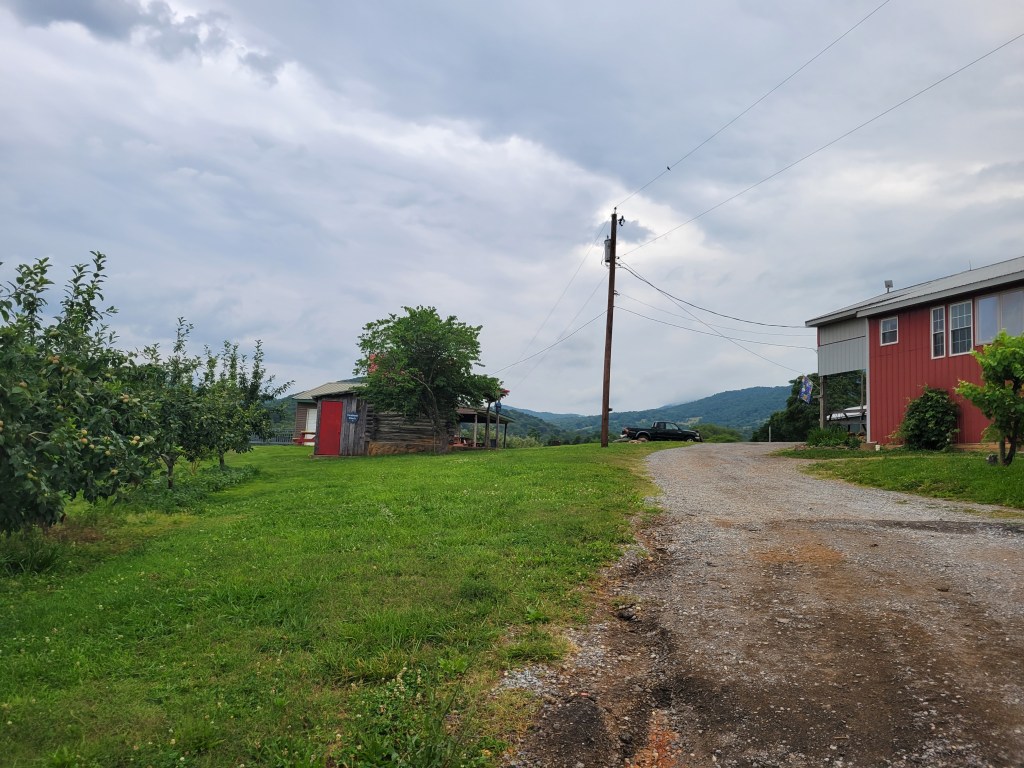
We spent a night at the Peaks of Otter Winery in rural Bedford, Virginia. On the edge of the Blue Ridge Mountains about halfway between Lynchburg and Roanoke, we were surrounded by orchards and tree-covered mountains.
We were greeted by Danny Johnson, a spry looking elderly man in a golf cart. After showing us where to park, he stayed and talked with us for a while. In his Blue Ridge drawl, he took us through the generations of his family and Bedford.
Danny, whose family has been in the area since the 1700s, was born in 1939 in a white house that still stood on the property. His father-in-law rode the rails around the country as a teenager in the 1930s. “He got off the train in the Blue Ridge about ten miles from here when it was stopped for rewatering,” Danny told us. “He saw my mother-in-law and didn’t get back on the train.”
He gave us the generation-by-generation history of his family and of other families in the area, showing us where each generation lived as he spoke, and indicating when people moved from one place to another and why. He would point and say, “They lived on that mountain there.”
We were in town for the next day’s D-Day 80th anniversary celebration at the National D-Day Memorial. Bedford suffered the greatest number of D-Day casualties per capita of any town in the United States, losing 19 people out of a population of 3,200.
Julie asked Danny if he had memories from World War II. “I remember listening to reports of the war on the radio,” he said. “When my father got the newspaper every day, the first thing he checked for was news of the war. I remember daddy doing that.”
His brother, who was 14 years older than him, enlisted in the Navy in 1945 and was on his way to Japan when the United States dropped the atomic bombs. “He still went to Japan after that to do clean-up.”
Upon learning that Julie had written a musical about World War II he said, “I’m glad to hear that. I’m worried people are forgetting about that generation. People are forgetting what that generation fought for. I’m worried something bad is going to happen in the world again. I wish the world could learn to be friends.”
He told us the history of how the National D-Day Memorial came to be in Bedford.
“On the 40th anniversary of D-Day, a New York Times article said something like, ‘In the sleepy town of Bedford, people don’t seem to remember it.’ My wife read that and said to me, ‘They’ll remember it on the 50th.’”
His wife, Nancy, then worked to make sure people remembered. She wrote several plays about World War II that were performed locally and spearheaded a project where students interviewed World War II veterans. Before that interview project, Danny said, none of the veterans ever talked about it. He knew WWII veterans, D-Day survivors (including his mailman), and widows all his life, but never heard their stories before that project.
A local person once told Danny, “The memorial wouldn’t be here if it weren’t for Nancy.” He then got choked up. “I just lost her in October.”
He told us how the community’s annual D-Day celebration has grown over the years. In advance of one of the early celebrations, one of his friends asked him, “Do you think you could feed some of my friends?”
“How many people are we talking about?”
“About 150.”
“So we did,” Danny said. “The next year it was about 350. A few years later it was over 1,000.”
150 years of America’s story were encapsulated in that conversation, from immigration to migration to a World War and fifty years beyond, told matter-of-factly by a sincere man in a golf cart.


 R and J in the USA
Leave a comment