Listen, before you dive into this particular rumination, it is important to remember that we are two human beings spending a heck of a lot of time together – averaging in the 24/7 range, much of it in a space no bigger than a walk-in closet and the rest of it perambulating down paths in the forest or sidewalks in a town, village or massive city. So we have had the opportunity to go deep into the most pressing of issues. And there is one that we have found ourselves having cause to peer unabashedly and courageously into its philosophical depths.
We have found ourselves deep in a grand inquiry for the ages.
It is this:
What exactly qualifies as a hike and what is simply a walk?
When you begin locomotion by the force of your own two feet, when does what you are doing cross over from the humble likes of “walking” into the more adventurous category of “hiking”?
We have tackled the question and are eager to report our preliminary results for peer review.
At first it seems simple enough. We all instinctively choose the word hiking without thinking too hard about it when describing an activity. We know when to use it and when not to use it. Though, we don’t always use the same words to describe the same event. Even so, one rarely hears anyone struggle to decide – we just intuitively grab the word that fits. Yet, like the concept and construct of time, it is easy enough to reference and utilize throughout your day, but good luck if someone asks you to actually describe what it actually IS. Try it. Try describing time. It probably seems easy to do, until you start trying. Go ahead and turn to a friend and start to describe to them what time actually is (WITHOUT using the word or concept of time in it’s own definition – including other words that mean or measure time, like “moment”, “minute”, “hour” etc…). How much TIME did it take for your brain to start melting?
So it is with hiking. And it is to this particular conundrum that we have directed our collective grey matter to attempt to solve. Mind you, we have used no digital assistance, we have referenced no dictionaries nor sought any other opinions. So, yes, this is a completely self-indulgent intellectual flagellation – and we are quite proud of ourselves as to our results.
We invite you to think on it first, before reading on, what you think classifies something as a hike and then compare notes and see if we succeeded in capturing whatever arises in your own insight or instincts.
Just a warning, before you get too deep, if it is not obvious already, a heads up that this post is deeply DEEPLY nerdy. You have been warned.
So…when we first stumbled upon the question, “what qualifies as a hike?”, we thought it would be an easy answer. The further we stepped in, the deeper down the rabbit hole we went and the sooner we realized, we were not in Kansas anymore.
It seemed simple to define it to begin with – a hike is an, at least, mildly strenuous, movement through a natural setting, ascending in elevation by which locomotion is accomplished through one’s two feet coming into contact with the ground at the same time.
This last part is, of course, necessary to distinguish it from a run or a trail run.
Okay.
Cool. Easy enough.
But then, we started to find ourselves in grey territory.
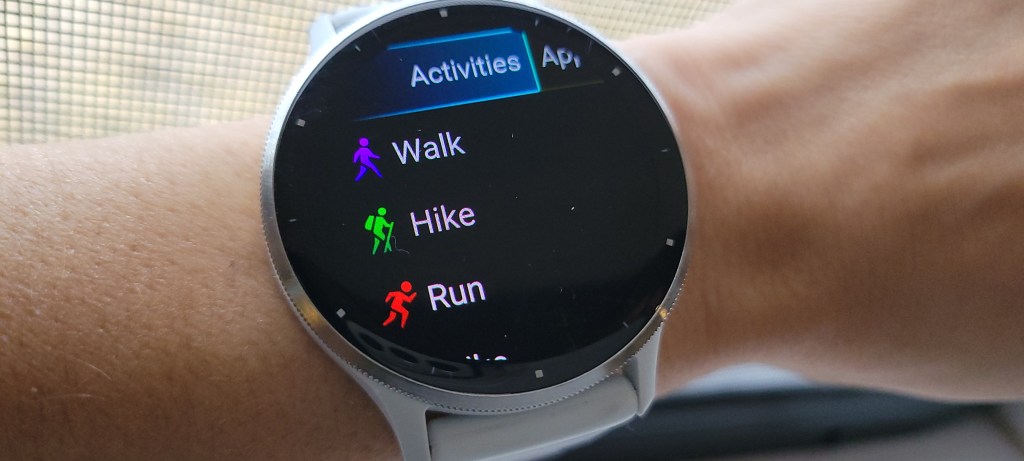
You see, our provocation into this particular rumination was practical in nature. We would encounter various opportunities to perambulate in front of us and still feel confused if what we were about to do was a walk or a hike. Julie likes to record things on her portable wrist computer known as a “watch” in modern times, more specifically a Garmin watch and she would often ask Ryan, “should I select the ‘walk’ or ‘hike’ category to record this activity”? We got ourselves into some whacky hypothetical territory and the game was most certainly afoot.
What if someone had a pack on their back with supplies to tent camp for five nights, walking through the flat areas of Death Valley’s desert, struggling against the forces of nature day after day? Would we call that a hike? By our original definition, it couldn’t be, in absence of the ascension in elevation. We decided, we certainly wouldn’t say that person was just “going for a walk”.
Then the thought experiment continued. What if someone was walking through a park filled with trees and wildlife, scaling one of San Francisco’s steepest hills, walking along a paved sidewalk next to a road?
That had all the hallmarks of our original definition – it is, at least, mildly strenuous, it is, at least a somewhat natural setting and was ascending in elevation.
But we couldn’t call it a hike.
What if we took out the “next to a road” part, but kept everything else the same? A case could be made that whether or not it was next to a road, even though there was no interface with the road and even if there were no cars on the road, could make the difference between whether it classifies as a hike or a walk. But it doesn’t change what the person is doing at all! How could this be?
And, how far away from the road does it have to be for the degree of “moving through a natural setting” to be counted? Then we remembered our definitive hike up Cadillac Mountain in Maine. There were parts of the hike that were on an old logging road. But it wasn’t paved. Is that what matters? There were parts of the hike that were parallel to a paved and busy road, but we were not on a sidewalk. Does a road going through a national park qualify differently than one going through an urban park in terms of how proximate it can be without negating the “in a natural setting”?
We drove through a town that was flat and saw a man walking along the sidewalk next to a busy road looking a bit worse for the wear and carrying a huge hiking pack. We had trouble saying he was walking. We felt we had to refer to him as a “hiker” even though the only thing in our definition of hiking that qualified him as a hiker was that he was locomoting. We had nothing in our definition about whether one is or is not carrying a pack. Why did that influence our definition? Why were we absolutely confident to refer to him as a hiker and felt fine thinking of him as “hiking through the town”. “Through a town” is the opposite of “through a natural setting”.
We had climbed more than one Adirondack peak with no hiking pack on our backs and felt more than comfortable calling those hikes.
Every time we head out to go for a, well, for a something, Julie would go to start the exercise on her Garmin watch and would stop and say, “Shall I press the “walk” or “hike” button?”
We found that, almost always, we agreed on whether something qualified as a hike or not, but we couldn’t point to any consistent definition of why. The variables were in constant flux, yet our sense of what something was or was not was consistent.
How?
This, of course, become delightful intellectual fodder to chew on and, after many such run-ins with the question, especially since, where possible, we wanted to “go for a hike” in each state where there was hiking to be done, we think we cracked the case. The answer we offer to what qualifies as a hike delighted our nerdy little brains to no end.
The answer is, the definition of hiking is not black and white. It is a determination that is qualified by a matrix of weighted components that must combine together to push the overall critical mass over the line from walk to hike. What we mean is, there are a number of conditional elements that have spectrums with degrees on them, and the definition of a hike is when there is enough cumulative elements of significant degree that, when combined together, they classify a hike. Pretty nerdy stuff.
Here is the list of relevant elements we came up with (we are guessing, when we first posed the question to you, you probably came up with a few of these, but maybe a different group of them then the person sitting next to you):
- Objective Physical Challenge – how physically or technically challenging an excursion is, regardless of the capability or fitness of the subject engaging it
- Subjective Physical Challenge – the degree to which the excursion is physically strenuous and requires physical exertion for the doer based on their own technical and physical abilities and fitness (note that because this one is, by definition, entirely subjective, meaning it is possible for something to get points towards being a hike for one person, but not for another)
- Naturalness of the Trail – the degree to which one’s ability to move through the setting has been shaped by humans or left unscripted and shaped by whatever natural forces, ecosystems and players are wild – trails can have various different levels of human cultivation, all the way from zero where there is no trail at all, not even a deer trail and one is simply making their way through whatever roots and brambles are there, all the way up to the most cultivated path through space of a sidewalk or paved road
- Ascension or Descension through Elevation – the degree of uphill or downhill that is being navigated
- Speed – the pace with which one moves through the terrain
- Supply Necessity – the degree to which one needs to carry supplies or forge resources out of nature’s bounty in order to overcome various human needs one might encounter over the course of the excursion
- Distance – the amount of terrain one passes (one is hiking the Appalachian Trail whether crossing the Appalachian Mountains or any of it’s flatter portions, simply by nature of the amount of distance they are covering).
- Duration – the amount of time spent in the act of movement.
- Relativity to Physical Context – the proportionality of each of these other qualities to other possible excursion in a nearby area (meaning, what might qualify as a hike in the middle of Nebraska might barely qualify as anything in areas near or around Colorado’s Rocky Mountains)
- Relativity to Cultural Context – often tied to the previous one, the degree of outdoor physical activity that is common to a culture of people that would influence what constitutes as a hike (what might count as going for a hike to the people of southern Illinois might barely be referred to as doing anything at all to the folks of New Hampshire’s White Mountains)
- Exposure to the Elements – the degree to which one must face and navigate nature’s elements (wind, rain, sun, water, lava, precipitation)
- Footing – the degree to which one’s footing requires attention, whether through an act of ascension, or an act of maintaining balance over an otherwise flat, but rocky, rooted or slippery terrain
- Natural setting – the degree to which one is immersed in an ecosystem unmanaged, uncultivated or unshaped by the efforts and preferences of humans
While we have not yet landed on a mathematically precise assessment of what, from this list is required, both in terms of quantity of elements and degree of each element, to constitute the sufficient components and quantities to qualify a hike, we’ve settled on the idea that, at least a handful of these elements must all be present to some significant degree IN ABSENCE of some negative degrees of the other elements that would cancel them out in order for it to be called a hike.
So, let’s get back to that multi-day walk through Death Valley. There is no ascension of elevation. There is no need for skillful footing. And, let’s say the trail is partially cultivated – not a paved sidewalk, but a clearly marked trail where major debris and impediments are removed and the need to engage a compass to maintain direction is absent. However, there is a necessity for supplies to navigate the various biological human needs one will encounter over its course from food to water to protection from the sun to shelter for sleeping and a method for excreting safely and responsibly. There is also exposure to the elements of wind, sun and extreme temperature. This, we could handle calling a hike through Death Valley, rather than a walk through Death Valley. The same activity of perambulating on that same path for a short 300 meter walk from the car in the parking lot to the center of a feature in Death Valley for a quick visit, however, definitely not a hike. Only when steeped in the conditions of this natural setting for a significant amount of time that introduces a whole new set of challenges beyond just the terrain to walk over, could this be called a hike.
But, change a few features, and that 300 meter locomotion to and from the car could become a hike if the setting were changed. One could park in a parking lot and ascend 300 meters through steep, rocky terrain, overcoming tree roots and navigating the twists and turns of a winding trail around nature’s features, quickly raising their heart rate to a pounding degree to reach a break in the trees, only a short distance from the car parked nearby, but exposing a beautiful view of a valley below, and one would be more than safe calling that a hike – a very short hike – but a hike nonetheless.
Now, let’s take that ascent along the steep roads of a park in San Francisco, scaling them along the sidewalk that runs next to the road. Now we’ll keep the steep ascension of our last example, but remove a few others. And, there is a natural setting where plants and animals roam wild, free and unimpeded by human control. There is some degree of objective physical challenge that one might encounter scaling the steepness. Despite the presence of those three things, none of them are at degrees that, when put together would be enough to tip the balance, since, underfoot is pavement, and all around us is a cityscape. You could possibly get away with saying you went for a steep walk, but, we’d be hard-pressed to call it a hike, unless in a tongue-in-cheek kind of way – “Did you walk here?” “Oh yea, and let me tell ya, that hill was quite the hike”. You are not going to say, however that you went hiking.
Now, the one significant wild card factor at play here is the one called “Relativity to Cultural Context”. We come from a cultural context, living in the state of New York where we have the Adirondacks, the Catskills and the Poconos all nearby with the Green and White Mountains not all that much farther away – none of them as grueling as the Rockies or the Cascades – but all of it making a heart-pounding ascension up a paved hill in San Francisco not qualify as a hike – to us. But, perhaps someone from the heart of Nebraska’s flat lands would say differently. We don’t know.
This is where our two subjective elements can have a profound influence making it so each potential excursion sits on a bell curve of relative definition. There will be things on both extremes that everyone agrees is just not a hike. No matter where you are from or what your physical ability, a short walk through a town center along a flat sidewalk will, likely by everyone, be considered a walk. An ascension up Mount Washington will, by everyone, likely be considered a hike. Then there are those that begin to fill in the bell curve until you reach the top with a well maintained soft, woodchip laden 5 foot wide trail through the woods of Ohio with occasional dips and small climbs probably falling at the top of that bell curve with 50% of the people feeling comfortable saying, after moving 3 or 4 miles through the woods on said trail, they went for a nice hike that day, and the other 50% only willing to say they want for a nice walk in the woods.
After we had been through reams of such scenarios, both hypothetical ones and real ones that we faced as we headed out to each next excursion through the mixture of horizontal and vertical space, we were feeling fairly confident that we had landed on an effective model. Then we had a moment of inspiration where we settled on a one sentence definition that we think could potentially capture and introduce the matrix system in which we had come to feel quite confident. So we offer this to you – a single definition of what classifies as a hike.
A hike is qualified by the degree to which one’s path and experience is shaped by, determined by, impacted by and subject to the whims, forces and movements of the natural world. The degree to which someone is subject to or protected from such forces determines the classification between a walk and a hike.
Another way to say it is:
A hike is determined by the degree to which a human must utilize their resources to navigate the demands of nature versus the degree to which human intervention allows the doer to be protected from pouring their resources into navigating any demand that nature makes.
Here’s our go at a super short single sentence:
A hike is the degree to which one, while perambulating, is surrounded by and subject to the forces of nature.
We were pretty sure we nailed it, but needed to take it for a spin to test it out to see if it really held up.
Let’s probe and dissect it to see if it holds up.
When a trail is created in the woods, the human is protected from the natural world’s demand for orientation that necessitates orienteering skills and time and energy invested in using those skills to attain that orientation. Without a trail, one must understand where they are and what directions they must move to go where they want to go or away from where they don’t want to go. A human must pour their resources into this orientation. If the human does not, they can become lost and ultimately lose a battle, even for their own survival. As soon as a trail of any kind is created that indicates where a human is on the landscape and how to get from one point to another without engaging their own resources to achieve that orientation, there is a level of protection from the whims and demands and forces of nature. Now, a trail that has been lightly cleared and marked through the woods can still very much qualify as a hike. The more cleared the trail is, the more specifically and often it is marked, the less and less this aspect contributes to its classification as a hike.
When that trail is distinctly made, but not protected from nature’s participation, there are roots and rocks to step over, streams of water that can run over or through, boulders to navigate or mud to slosh through. This requires a human to pour their resources and energy into navigating nature’s demands much more than a 5 foot wide gravel or softly woodchipped path would do.
Let’s look at another component – supply necessity – under this new definition. This is an element that can speak to the degree to which one is subject to nature, not just around us, but the nature that is present in our own biology. We require nutrition, hydration and necessitate excretion of waste products. Simply by being on a trail for a certain amount of time, we become exposed to the natural demands within our own bodily functions. What might be classified as a walk if it were for 30 minutes, when done for 3 days, requiring supplies just to manage our own biology, from hunger, to thirst, to the strength of our strong but vulnerable skin as it potentially bubbles up into a poppable and injectable blister, our sours under the heat of too much sun, or succumbs to the hungers of nature’s various biting beings, might be enough to push it over into “hike” classification.
Then there are the supplies needed to navigate the external demands of nature that interface with our biological demands. We biologically require protection from infection – so, depending on the setting and time in it – we may need first aid gear. An exposed cut on a short jaunt down a sidewalk to walk to the nearby convenience store is still exposed to infection, but that same open cut or blister present when exposed to dirt and weather and time is a different threat. Or the bacterial threat of infection that can be part of getting adequate hydration for our biological necessity. An excursion that is short enough to be tended to by the contents of a small water bottle are different than those that require some sort of strategy to turn stream water into safe hydration.
There are also supplies needed to protect our biology from the attacks by wildlife big and small, like firearms or bear spray all the way down to the teeny but very real threats of bee stings, mosquito and tick bites.
We recently attended an event in Yellowstone National Park that was called a “Guided Ranger Hike”. We both wanted to get a hike in during our time in Yellowstone. We went on it and we both experienced almost no physical exertion. There was little to no ascension in elevation at all. It physically felt like a walk. Yet, we were both very cold and wet, anxious to get back to the warm protections of our van. It was called a “Guided Ranger Hike” because there was an added safety against the threats of Grizzly Bears, Elk and Bison that, thanks to the numbers we were gathered in and the skills and supplies carried by the ranger that could provide intervention between the participants and any dangers present in the wild, we didn’t need to utilize our own resources to navigate as we would if we had been on that same excursion just the two of us. There was a clear and easy trail to walk, but it was one that still had nature under our feet and we were surrounded by the world of nature on its own terms throughout the duration. They advertised it as a hike, we called it a hike. We came back cold and wet, but not physically tired. But, it was a hike. Now COMPARATIVELY, compared to a hike up one of the mountains in the park, comparatively, it was definitely a walk. This is one of those that might fall in the thick of the bell curve. It would be acceptably called a hike, but no one would be confused if someone referred to it as a walk.
After all of this intellectual indulgence, there may be well settled upon definitions for what constitutes a hike and we could have easily looked them up, but we have had too much fun thinking about it while walking and/or hiking to ruin the fun by seeking the easy out of a dictionary or the assistance of google’s AI technology. As a result, you have this excessive treatment of the issue to read. If you’ve made it this far, whether you like it or not, you’ve probably got a little bit of nerd in ya too and we deem that you have gone on an intellectual hike through the wild woods of our weird and wacky brains. If there are any conditions we missed on our list of matrix elements, do let us know. In the meantime, and we mean this in the most sincere and loving of ways, take a hike.


 R and J in the USA
Leave a comment