September 14, 2024
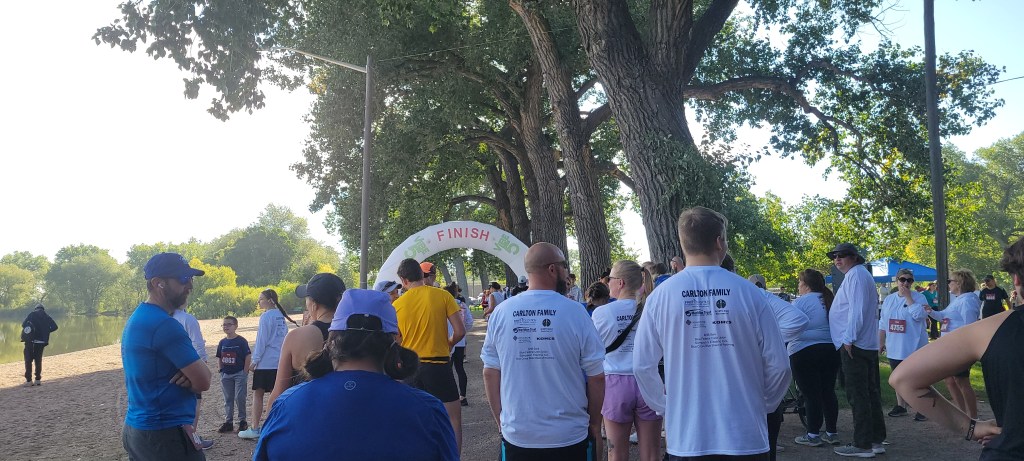
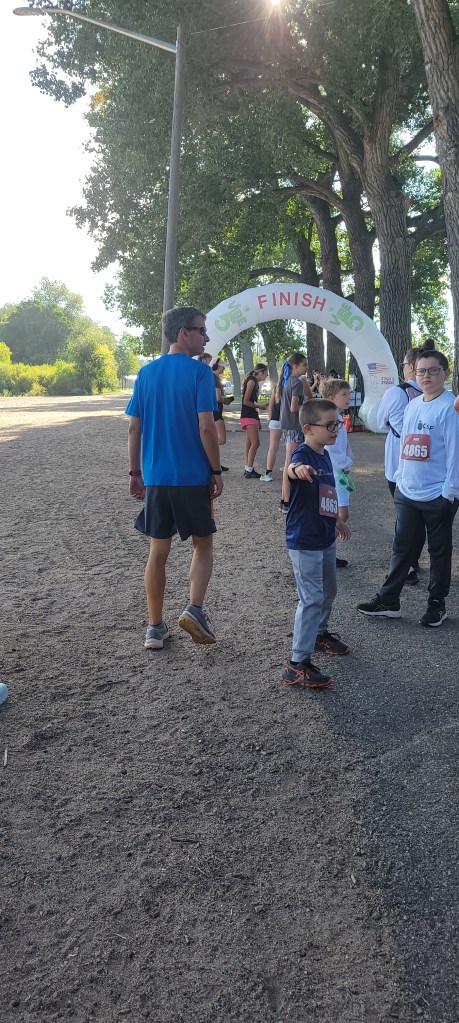
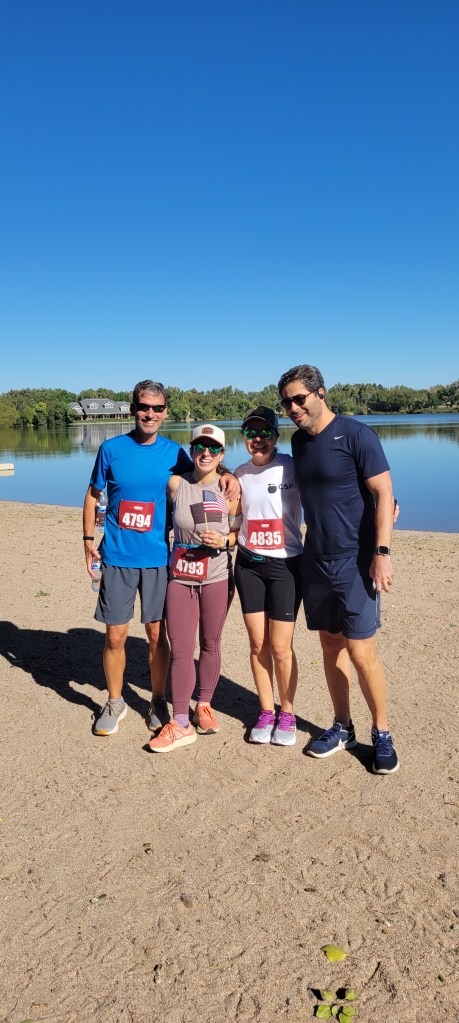
It was a sunny Saturday morning in Cheyenne, Wyoming, for the Run for #1 5K.
The Run for #1 5K was a fundraiser for the Cheyenne Schools Foundation, whose mission is to provide grants for Cheyenne engaging and innovative classroom programs that are beyond the capacity of the local school district budget.
The race took place in Lions Park, just down the road from the Cheyenne Frontier Days Old West Museum.
The course was an askew figure eight, with runners staying on the outside of the stacked loops in the counterclockwise direction rather than crossing over at the touch point of the two loops. The race began and ended at the base of the lower loop, with three quarters of a mile of flat park path to begin the race and three quarters of flat park path to end it.
The entrance to and exit from the upper loop was a short but significant down and up into and out of a sub-highway pedestrian tunnel. In between the two passes of the tunnel was a mile and a half of sneaky uphill pitch. It was one of those grades that looks flat when driving it in a car, but tells a different tale when running it. In a reversal of the ideal state of children in the old days, who should be seen and not heard, this slight uphill pitch was felt but not seen. And it persisted throughout the entire loop, even though the loop finished where it started. It turns out that ‘uphill both ways’ is a real thing.
Despite the M.C. Escher twist of the middle mile and a half, the biggest challenge of the course for us non-locals proved to be not its topography, but rather its altitude. Cheyenne sits at an elevation of 6100 feet, which sends a message to the lungs of the uninitiated. And that message is, “Ouch.” We didn’t know beforehand what the altitude was, or even think to consider it, as we had not encountered elevation as a factor in any of our previous 5Ks. And we paid the price, as this race felt noticeably harder than any of our previous races, thanks to the thin air.
Despite the altitude-induced discomfort, we both managed to cross the finish line. Ryan finished 2nd out of 3 in his age group and 4th out of 140 overall. (The overall race winner was in his age group.) Julie finished 4th of 14 in her age group, 14th of 92 females, and 31st of 140 overall. The overall winner finished in 19:36, and the top female finisher finished in 24:41. Full results here.

Detailed Race Report for Running Nerds
Despite an early and relaxed arrival at a very peaceful Harvest Host the night before the race and a nice relaxing evening and early bedtime, for whatever reason, we both woke up around 1:30 AM and didn’t fall back asleep until almost 5:00 AM. As a result, we both showed up to the starting line with a little less pep in our step than usual.
It having been a full and enjoyable week since our double duty day of two 5Ks in one morning, we were both feeling some degree of recovery. Ryan’s race performance graph has continued to show a steady, consistent upward trend with no signs of abating. With that confidence in tow, despite not feeling as loose as he would usually like before a race, he confidently kissed Julie goodbye and wished her a good race as he headed up towards the front of the crowd. Julie, both knowing that she was definitely no longer in better shape than Ryan and most certainly in much less shape than Ryan, and also that her primary goal was to take a cue from Ryan and try to run this race casually, without trying to be a hero, stayed in the middle of the pack and wished him a great race.
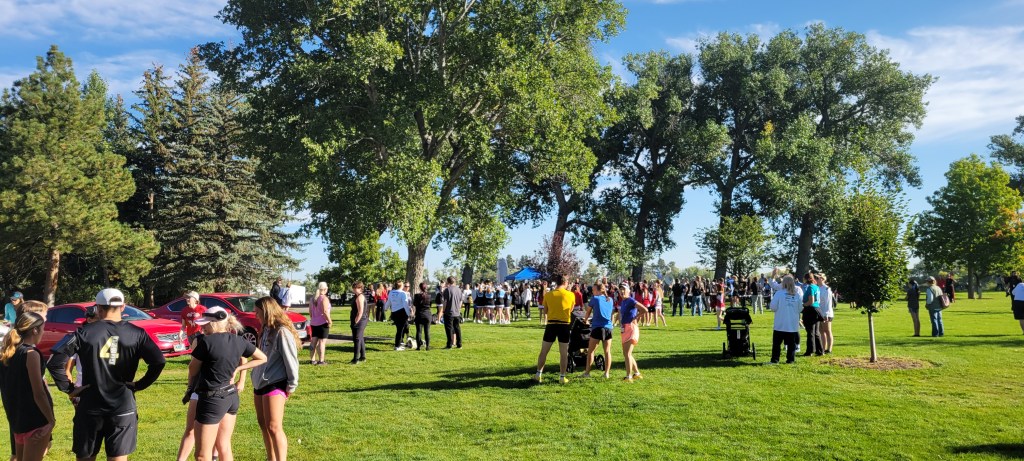
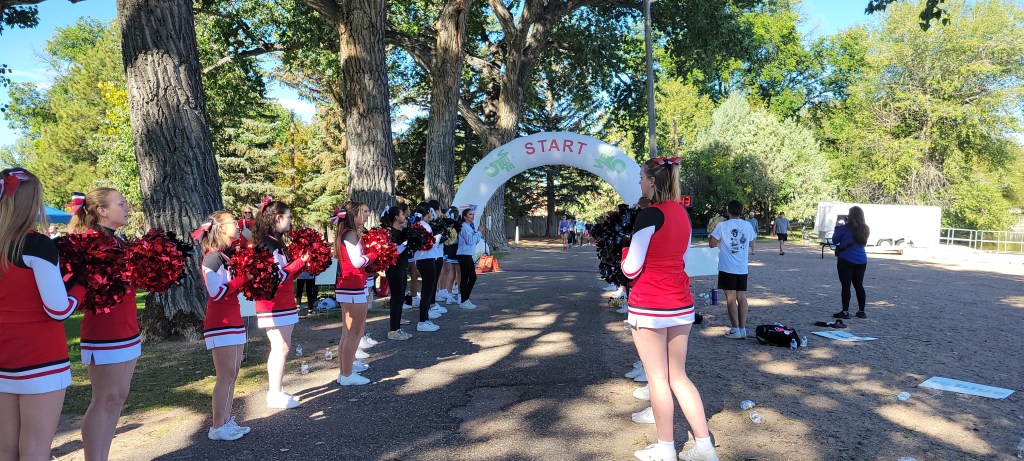
The atmosphere of the race was a blast, with high school cheerleaders and bands ceremoniously sending off the racers. At the gun, Ryan was off with the front of the pack and Julie was happily beginning in the forward end of the middle of the pack.
As for Ryan’s race, he started to feel a level of discomfort near the end of Mile 1 that he doesn’t normally feel until later in a race. He wondered if perhaps he had started off too fast for the level of looseness he felt pre-race. He thought that perhaps his short morning run the day before followed by a 4.5-hour car ride left him a little tight. Even though he did his usual pre-race warm up, he still started the race feeling a little sluggish. At least that’s what he thought he was feeling. A look at his Garmin watch told him he was going at a pace that was reasonable for his current level of fitness, so it didn’t seem like he was going harder than he should. But he was really feeling the hurt pretty early in the race, and he couldn’t figure out why.
When the water station showed up around Mile 1.5, he stopped for 5 to 10 seconds because he just wanted a break. He wasn’t sure if that was the right move or not, but that’s what he did. He pretty much felt lousy the rest of the race and for the entire Mile 3 just wanted to stop. He was very glad to cross the finish line, and afterwards spent a minute or two with his hands on his knees catching his breath.
Ryan later struck up a conversation with the race’s overall winner, Jerry. Ryan told Jerry how surprised he was surprised at how much discomfort he felt so early in the race. Jerry, a local, responded, “Well, you might be feeling the thin air. Our altitude is 6100 feet around here.” Ryan immediately thought, “Well that makes sense.” He now understood why he felt so depleted during the race.
Ryan wondered if knowing about the elevation before the race would resulted in him running the same pace and viewing the altitude-induced discomfort as simply another factor to manage or if it would have caused him to adjust his pace and not run so hard. The question lingered for him. Was it better that he did or did not know? If he had known, he may have simply filed it away and been just fine, having known what the source was of the unusual level of discomfort.
Whether it would have been better or worse is anyone’s guess, but we know for sure that Ryan took fourth place overall in the race with a 22:47. So all in all it turned out okay.
As for Julie, she came into the race less fit, less strategic, less warmed up, and breathing the same thin air.
When she started the race, feeling generally recouped and recovered from a great week of easygoing workouts, she once again had no idea what level was in the tank. The only thing she knew was she wanted to keep this a low heart rate race. She planned to run whatever pace was necessary to do that, having no idea what that would be. She started out at a gentle 8:45 pace. After holding that for the first couple hundred yards, she looked at her watch and was surprised to see she was succumbing to that common race start phenomenon of running too fast. She was running with the crowd at 7:50. She was surprised by how comfortable it felt and thought, oh, am I back in business? She really had no idea what her legs or lungs or heart had in store and was fine to discover it along the way.
She thought perhaps she would hold a nice steady pace somewhere between 8:00 and 8:15 per mile. Looking at her watch, she saw the pace creeping up to 8:30. No problem. Next peek, 8:50. Okay. Got it. Let’s keep a nice 8:50 pace.
That’s when she noticed she was breathing pretty hard for 8:50. She looked at her watch and saw that her heart rate had somehow in the last few minutes crept from its 145-148 range to 170-173. Dang it, she thought. She could see what she would have to do to keep a relaxed pace. The problem was, her legs had so much juice in them. Her legs could have easily run a sub eight-minute mile, but her lungs and heart were not on board.
After the first mile came in at 8:59 she remembered her pre-race commitment to herself and, despite wanting to push it and run faster, she submitted. She remembered what she had seen in Ryan. How much he had been willing to listen to his body and not try and be a hero, taking the first eight races or so to just warm up his body and shake loose the cobwebs, walking when he needed to and running nice and easy when he needed to. And now look at him go. And Julie remembered that’s exactly how she got to the level of fitness she had at the beginning of the trip. No pushing for progress, just going out and running once per week, then twice per week, then three to four times per week, letting every run be determined by what her body felt like doing, with a little bit of strategy in the distances she would choose from jog to jog.
With her own personal and observed reminders of the value of listening to your body, especially during an undertaking as physically strenuous as this trip, she surrendered. Mile two became a walk-run. She would run whatever pace felt natural until her heart rate crept above 170, then she’d stop and walk until it came down to at least under 160, or sometimes under 150. Then she’d start up again at whatever pace felt natural. When she hit the water station, she stopped to drink two cups of water before carrying on. For Julie, this level of restraint took more discipline than the discipline to run through the pain. But she knew if she wanted to return to form sometime in the trip’s remaining 5Ks, this was the only way to go. Mile 2 clocked in at 11:25.
At the beginning of mile 3, she felt more pep in her step and was easily running 8:40-9:05 for much longer. At about 2.5 miles, she saw her heart rate had gotten up to 175. She decided, okay, there’s only a bit left, let’s just carry on and try not to let it get higher. She ran the rest of mile 3 without walking and clocked in at a 9:14 pace. This was one of the few runs where she didn’t have much left at the end for much of a kick. Maybe a small one, but there was a little extra something zapping her. Something she didn’t understand until crossing the finish line just past the 30-minute mark at 30:24 with an average pace of 9:47 and an average heart rate of 163. Not too bad, not too great. Would have been nicer to keep the heart rate lower, but overall, she counted it as a success. She was relieved to get an answer to that extra level of tough she felt when Ryan informed her of the 6100 feet of altitude in Cheyenne.
Either way, the best part of the race came just after the finish line with the local cheerleading squad lining the race chute and doing a full-on coordinated cheer for every runner that passed the line. Well done, Cheyenne.
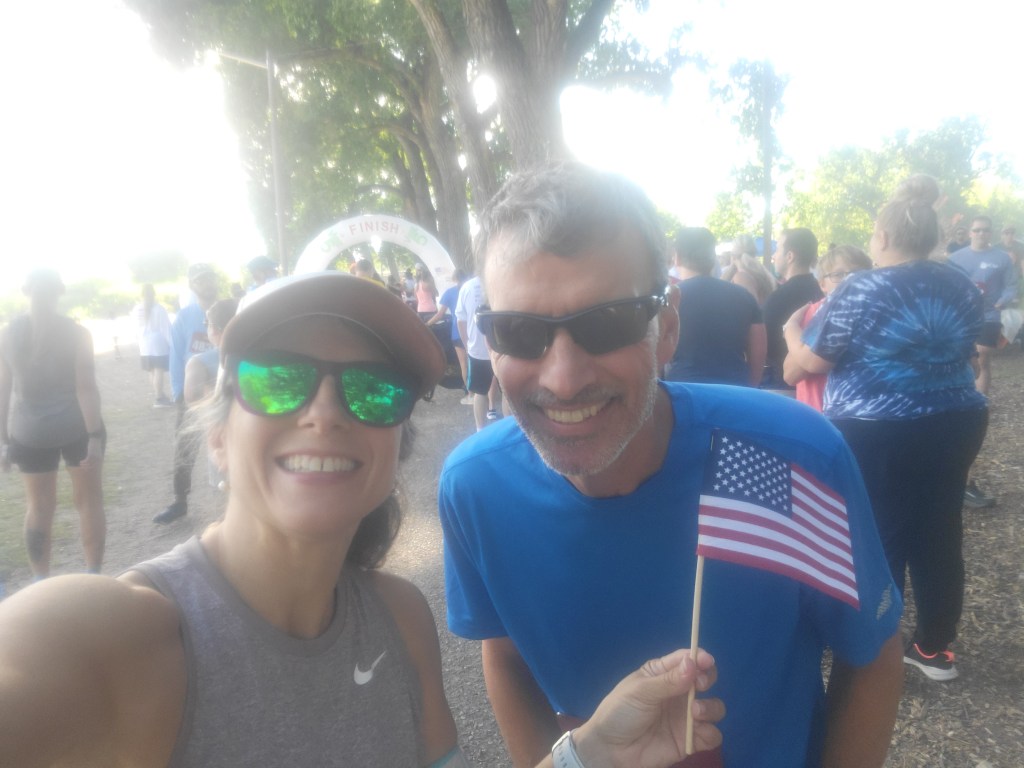
The race between Ryan and Julie was now long past close as he cheered her across the finish line after standing there for almost a full eight minutes. That’s 8 races for Julie to 12 for Ryan. And all signs point to, he’s only just getting started.
 R and J in the USA
Leave a comment