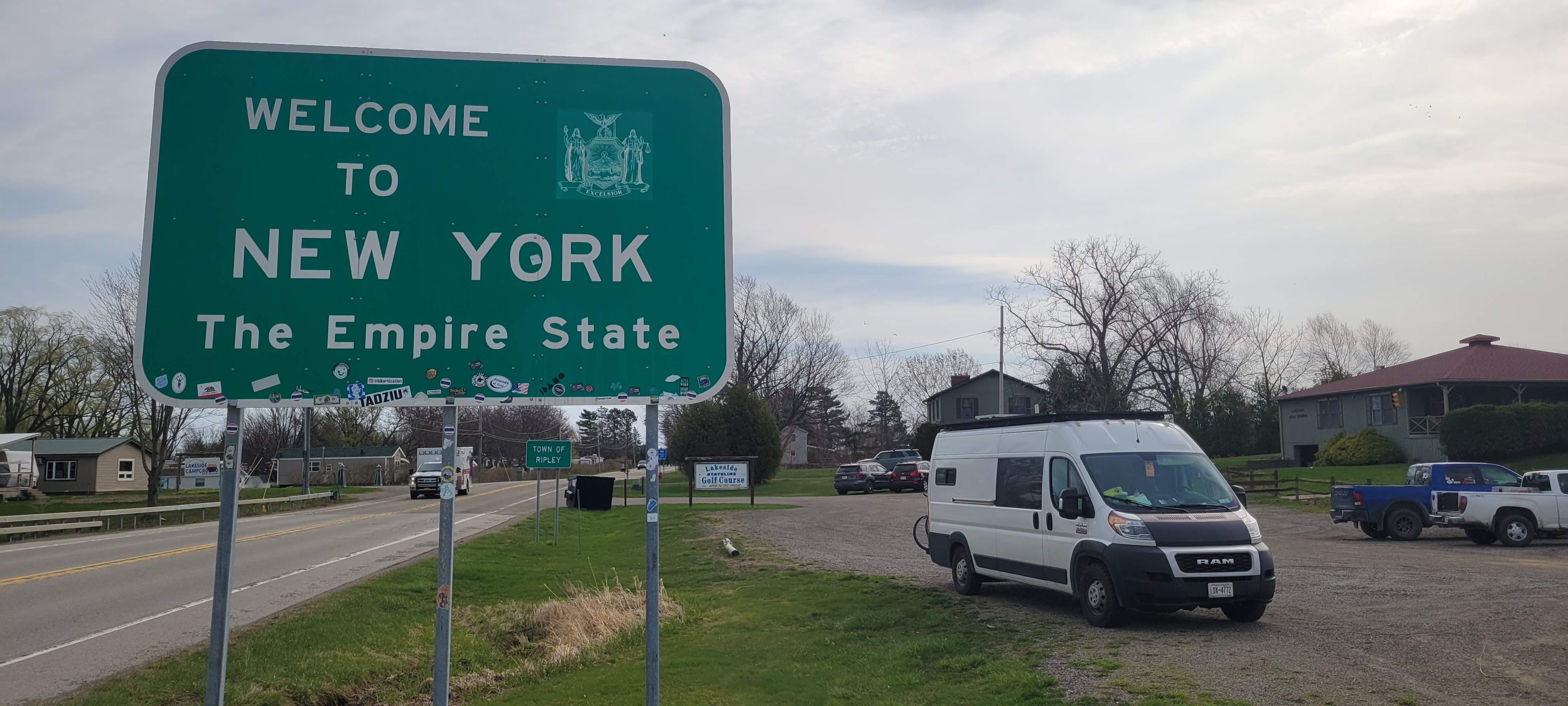

This blog is not meant to be political, nor do we wish to make political statements in it or with it. But this blog is about traveling the United States of America and a pursuit to participate in this group of which we are a part. And, at the time of this writing, November 5th is right around the corner, and, as Americans, we are aware of the impending decision that we will be making as a country with every bit as much weight as the next person. And, a little context that, while not political, is politics adjacent seems necessary to set up this next “People Along the Way” conversation.
We are independents, without affiliation or loyalty to one particular party or another. What we care about are the values we hold dear and the values that we believe are central to what America stands for. When we vote, we are always seeking to vote for someone that we think can operate from a principled place and do their best to facilitate effective collaboration amongst the many different viewpoints, preferences and priorities of everyone across the country, as much towards the betterment of all as possible. We are both much more focused on civic culture and the process by which conversations are had and decisions are made than we are attuned to any particular party or policy position. We both long to be part of a culture where open dialogue and a constructive exchange of ideas is not only possible, but commonplace. We have very few stances that we are dug into without an interest to hear what a person of a different viewpoint has to say, with a willingness to have our own viewpoint challenged, changed or expanded with nuance by the input of others with different backgrounds and perspectives as ours. But, it is hard to be enriched and expanded when the conversations are not available. That was one of Julie’s biggest hopes and dreams on this trip – that we would have conversations with people that, if it was only YouTube comments or flags to fly, we might otherwise find ourselves at odds with, but that we could connect as human beings, as fellow Americans and find a place to have a dialogue, one where we could hear points of view that we hadn’t considered and where we could share ours as well. And we’ve had more than a handful of these types of conversations. Each of them have only been a drop in a bucket of a larger dialogue that is needed, and none of them have been about political choices in a specific way. Julie’s ultimate goal was to have at least one conversation where she could really get into the politics of today in a way that was positive, mutually beneficial and enriching – and, at least – not contentious or alienating.
Julie met a woman at the capitol and had the pleasure of sparking up a conversation with her. She was a lovely woman, friendly and engaging. Before long, Julie and Sandy were in a delightful conversation about Topeka and our 50 states tour.
”Are you from Topeka?” Julie asked.
”Born and raised. Lived here all of my life.” Sandy said.
”That must mean you like it.” Julie said, realizing as soon as she said it that that was not necessarily true – a person could absolutely stay in a place for many reasons other than liking it – a thought that Sandy confirmed with her face filled with mixed emotions.
“There is not as much going on as there used to be.” Sandy lamented.
She went on to share how she did like Topeka, but regretted some of the changes to downtown over the course of her six plus decades of life lived there. She said, when she was coming up, 18, 19, 20 years old, she could stay out until 3 or 4 in the morning partying and even get an early breakfast. Not so anymore. When Julie inquired as to what happened, Sandy simply didn’t know.
They got into talking about where Julie was from. When Julie said she was from upstate NY, Sandy responded in a way that north of 90% of people do…as if Julie had just said that she lived in NYC.
“Oh, I’m sure you have lots to do there.”
”Well, I’m actually not from New York City.” Julie said “We actually live a good 5.5 hours from the city.”
Sandy showed surprise, not realizing there was so much of New York. Most people who are not from New York, or at least not from the northeast, seemed to have the same misconception.
”That’s one of the reasons we are excited about this trip.” Julie said. ”We are the same about all the states far from us. We didn’t know many things about Kansas other than Dorothy and farmland. And, almost every state that we are not from that we have never been to, we only know the most famous thing about it. So, I understand.”
Then Julie went on in her role as self-appointed ambassador for the state of New York and told Sandy about all the different parts of it, like the Finger Lakes, Niagara Falls, the Catskills and the Adirondacks and that we were also on one of the Great Lakes. Sandy seemed quite enthralled and grateful for the education, as was Julie for the education she was getting from Sandy about Kansas and Topeka.
Sandy noticed the small American flag in Julie’s hands and asked her bout it.
”I carry it in with me to every capitol visit. I guess I don’t know exactly why, but it just feels right to carry it.”
”Well, you’ve got to follow what feels right.” Sandy said. ”And, it’s a good thing to carry around now, especially with the election coming up.”
”Yea,” Julie said, excited about the possibility of being able to have a peaceful dialogue.
“No matter who wins,” Sandy said, “I don’t think it’s going to be good.” she said with relatable concern about how the other half of the country would react to whomever was elected. “I hope I’m wrong, but that’s what I think.”
”I hope you’re wrong too.” Julie said
Julie continued, “Well, we are on this trip to try to meet our fellow Americans. I just feel like these days, everyone can be so mean to each other, when we need to remember we are all one country.”
Julie didn’t want to push the conversation too far, as it was already such a lovely and friendly one, but Sandy took the next step and revealed who she was voting for. This post and this blog is not meant to be political, and, that would be a distraction from the story we are actually trying to tell, so we will tell it in absence of naming particular candidates. The important part is what happened next, which all could have unfolded almost exactly the same no matter which of Sandy or Julie were voting for which candidates.
“Do you mind if I ask you a personal question that is about your politics?” Julie asked.
They had already built enough of a report that Sandy seemed open and unthreatened and Julie was doing everything in her power to show that her curiosity was sincere and not meant to be combative.
“It’s hard for me to understand the appeal of [your candidate]. Would you be willing to help me understand? What is it that you like about [that person]?”
Julie could tell Sandy was still trying to get the full understanding of what Julie was asking, but once she did, she opened up with total willingness to share. Though what she shared was not even a drop in the bucket of how deep the conversation needed to go to really help Julie understand, Julie was so grateful for Sandy’s willingness to open up and share with someone that she knew was not a fan of the person she was enthusiastically supporting.
The conversation carried on, with each Julie and Sandy saying things that likely exasperated the other with mild disbelief because the viewpoint was so different, but both responded kindly and with more questions to try to understand each other and both conceding certain possibilities. Nobody’s mind was being changed on either side, and neither was trying to persuade the other, just trying to understand.
Julie at one point said how she wished it was more often possible to have conversations with each other like this.
Sandy eventually offered up that, “Our family won’t talk to me and my husband because of who we are voting for.”
”Oh, I’m so sorry to hear that.” Julie said.
“It’s their problem.” Sandy said with strength and defensiveness of her right to have her opinion and cast her vote as she wanted to cast it. Julie wondered if, under that strong exterior, it still hurt.
While Julie understood the intensity of emotions that Sandy’s family might be feeling that led them to this estrangement (also knowing that Julie knew nothing about the family dynamics and they may well be way more complex than just political), as Julie’s distaste for Sandy’s candidate was deep and strong as well, but Julie was sad to hear of this breaking of family bonds as a result.
Our perspective is that the breakdown of connections, dialogue and the ability to be curious about each other is the more dangerous trajectory to be avoided – that this is what matters more than any one policy, or even any leader that occupies that singular office (not to say these things don’t have tremendous impact as well). We, meaning us, Julie and Ryan, have a tendency to think it is the ability of the people as a whole to mix amongst each other with different points of view and hash it out that is one of the most important ingredients of this American experiment. It takes mutual willing parties to do that and it takes a willingness to hear things that boggle your mind, hurt your heart and terrify the ever loving shit out of you to be able to make progress towards common understanding and, even common ground. Instead, as we see it, it seems that people are more often avoiding the discomfort of facing those frictions for the comfort of their own echo chambers where everything fits and makes sense – where you don’t even have to explain yourself because everyone you’re talking to is coming from the same place. And that’s nice to have and important too, but it’s not enough, at least in our humble estimation. We are so far from being a perfect country, but we believe our aspirations are sincere. At the end of the day, we wonder if there is really any president that can have as much power as 300,000,000+ million people who are capable to talk to one another and work together amidst differences.
It wasn’t the only point of the trip and not the central focus of our efforts or energies to have these conversations, but having at least a handful of them outside of our own echo chambers was one of our goals. For this reason, Julie was loving every second of this rare opportunity to do just that with Sandy.
Sandy and Julie’s conversation continued. Julie wished it could have gone on for hours and hours as they were only scratching the surface and Julie wanted to understand more.
Julie shared some of the things that she found deeply troubling that Sandy’s candidate and VP had said, and Sandy showed Julie compassion and care in response. It was sincere and lovely. Julie was fairly confident that if this conversation had started with either one of them trying to convince the other of the wrongness of their position, such compassion would likely not only not have had the room to arise, but may, instead, have been replaced by some vitriol or aggression. Maybe not, but maybe so.
And, as Sandy started to ready herself to go and Ryan and Julie headed towards the door, Sandy turned and said to Julie, “Thanks for not being mad at me.”
The look on Sandy’s face and her words landed like a shot directly to Julie’s heart.
Julie knew it was a teeny tiny little step in the massive ocean of the hundreds of millions of us that make up this country, but she felt like she did a little bit of what she had hoped she could do to make a contribution towards the country that she wants to live in.
Julie smiled and waved her little flag at Sandy, “We’re all Americans. Thanks for talking with me.” she said. Sandy smiled.
They waved goodbye, each knowing that the other was going to cast a vote for someone that the other found reprehensible. They both thought each other’s candidates were liars. But, they expressed care for each other as human beings and hope that, on November 6th, no matter who is tallied up as a winner to occupy the highest office of the land, the people of this land that had cast their votes would find a way to listen and to stop being so mad at each other.
 R and J in the USA
Leave a comment