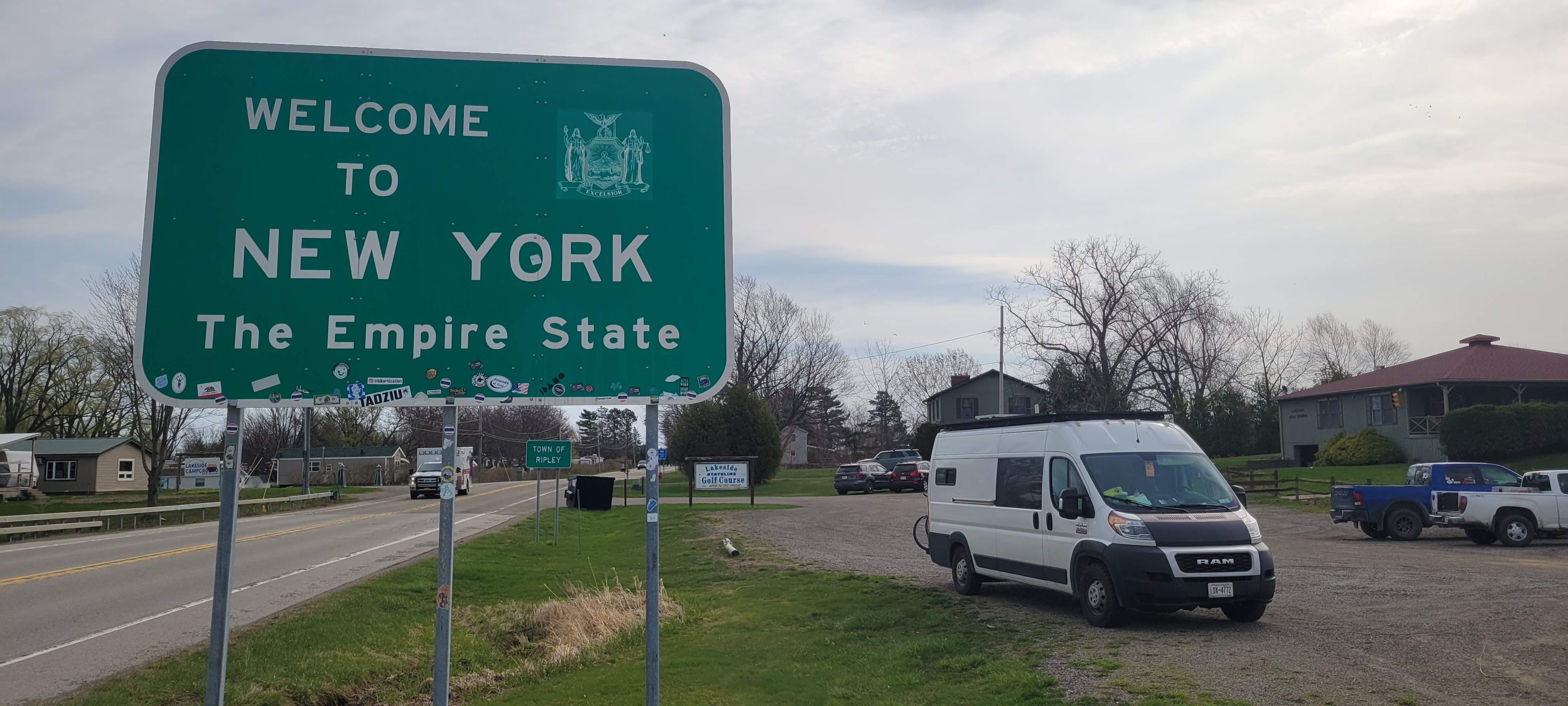
While Julie was wandering through the New Mexico History Museum she was going through the familiar set of revelations and emotions that are par for the course while learning about nearly any section of American history – a strange mix of disappointment, disgust, disillusionment, hope, anger, inspiration, awe and pride was stirring in her.
She had just passed through the part of the museum that moves from telling the complex story of New Mexican history that has to do with the dance of Spanish colonialism that the landscape and the natives that had long called that landscape home had been deeply engaged with – a complex story that Julie left the museum wanting to learn more about – and she had then entered the section that described the American colonial path. She read things that, like many museums before, tied her mind, her heart and her stomach in knots.
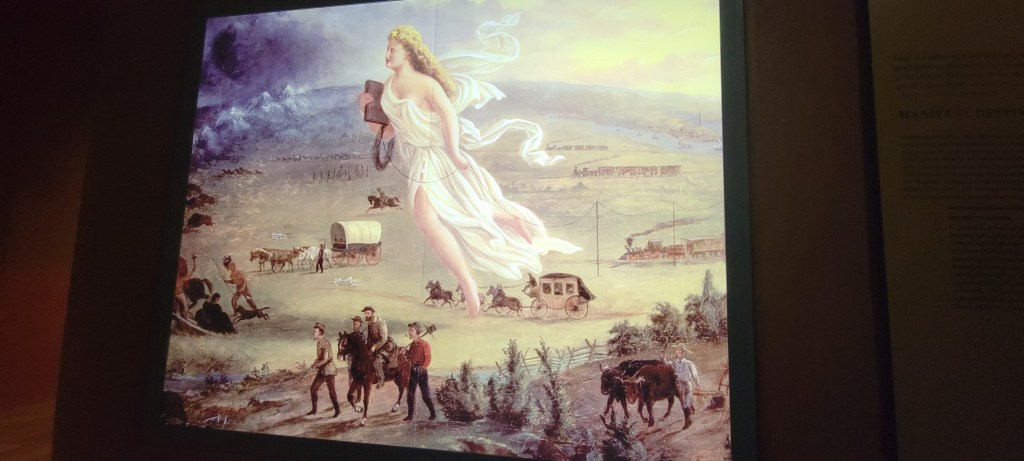
”Our manifest destiny is to overspread and possess the whole continent which providence has given us for the…great experiment of liberty…” John O’Sullivan, New York Morning News, 1845
Julie remembered learning about Manifest Destiny in school and doing so in a rather simplistic way. Whether it was the way it was taught or the degree to which Julie was able to process it at the time, what she read next was a much more disturbing paragraph than what she remembered internalizing growing up, but something it is nearly impossible to travel the country without seeing in every nook and cranny of its history if one is actually willing and interested to go to the museums, read the books, look at the monuments and stare at America’s ugly past directly in the face.
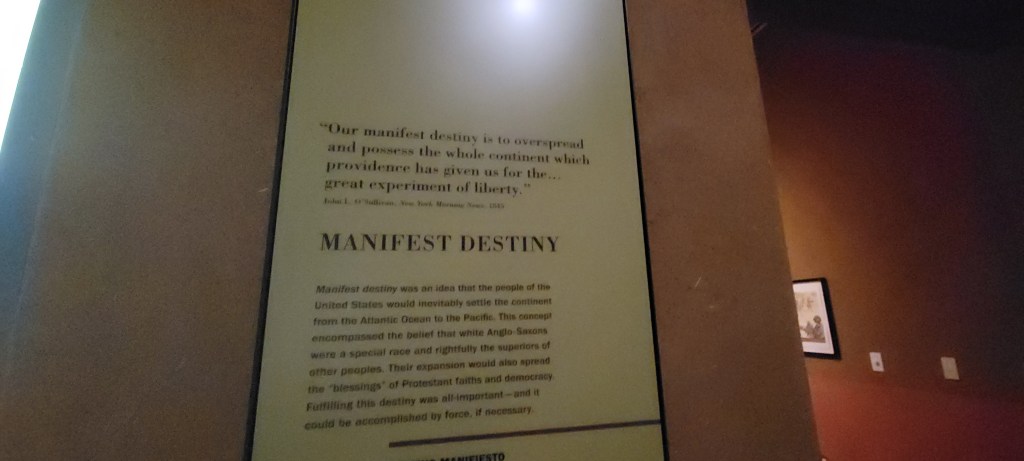
”Manifest Destiny was an idea that the people of the United States would inevitably settle the continent from the Atlantic Ocean to the Pacific. This concept encompassed the belief that white Anglo-Saxon were a special race and rightfully the superiors of other peoples. Their expansion would also spread the “blessings” of Protestant faiths and democracy. Fulfilling this destiny was all-important, and it could be accomplished by force, if necessary.”
It is not that this paragraph’s truth wasn’t evident in every single state museum we’d been to. It’s not that this paragraph’s truth wasn’t evident in every single chapter of United States history. It is impossible to avoid seeing this attitude of a “special and superior race” at the root of American history at every moment that a race other than that of the European settlers was encountered and Julie is not so naive as to think otherwise. But, every visit to a museum for her still somehow ushered in a renewed surge of turmoil and moment of confusion of what to do with that information and how to reconcile being proud to be part of a country that stands for freedom and liberty when the root of that concept and all of the ugly ways it has been carried out is tied up with the idea of there being a superior race and that the spread of liberty can, in any way, be accomplished by the use of force and still hold it’s purity as the concept that Julie feels inspired by. How can liberty ever be forced upon anyone and still be considered liberty? Of course, it cannot. But this is the crazy, strange, ugly, beautiful, inspiring, devastating and robustly human story that is there to be told. Julie’s blood curdled and her stomach turned when she read the words, “a special race and rightfully the superiors of other peoples”. This seems to be a phenomenon that human beings throughout the world and history are susceptible to – the self-proclamation of superiority – and the justification of unspeakable and incomprehensible violence against others as a result. Millions upon millions upon millions of people have died, and died horrible deaths, just in the last hundred years along these lines of thinking, let alone the centuries before.
Julie was dealing with the now quite commonplace confusion and internal turmoil that is just an average walk through a state history museum when the sun came out and pulled her right out of those dark clouds.
And the sunshine’s name was Marvin.
Marvin had a distinct glow about him. Sometimes you meet people that have that certain glow in their eyes that tells you they are seeing the world in a beautiful way. Unfortunately, the picture Julie managed to get of Marvin did not do that glow justice, but in person, it was inescapable.
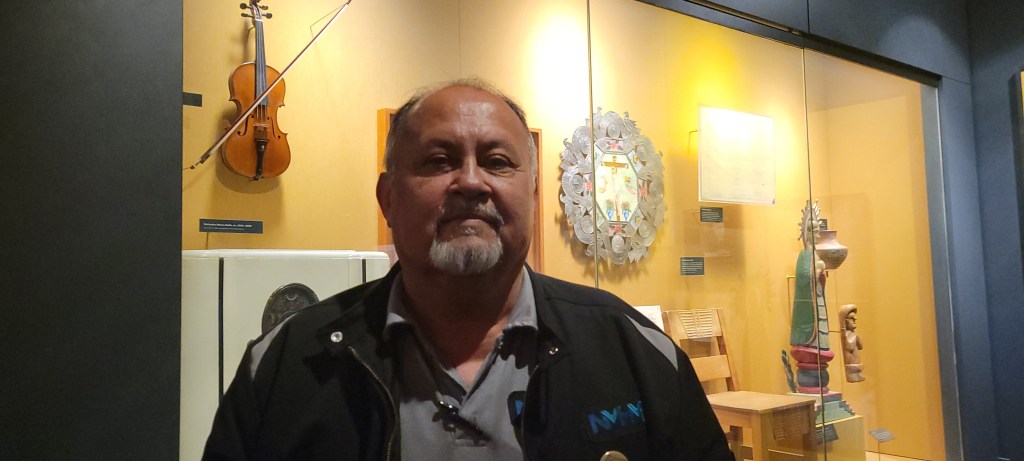
Julie was standing on a staircase headed down into the section of the museum describing New Mexico’s path to statehood, then into the World War I section and then the World War II section.
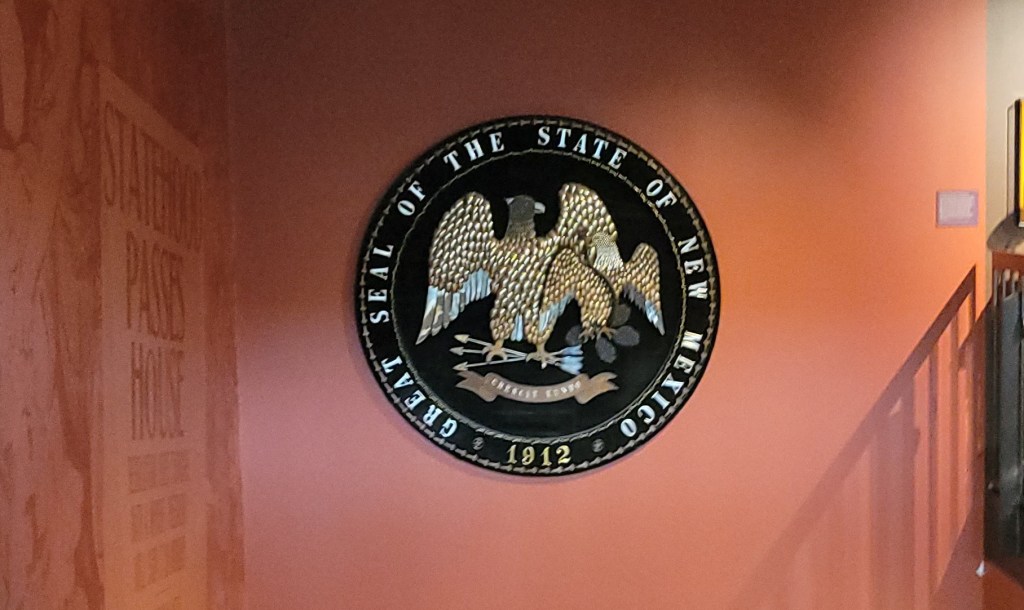
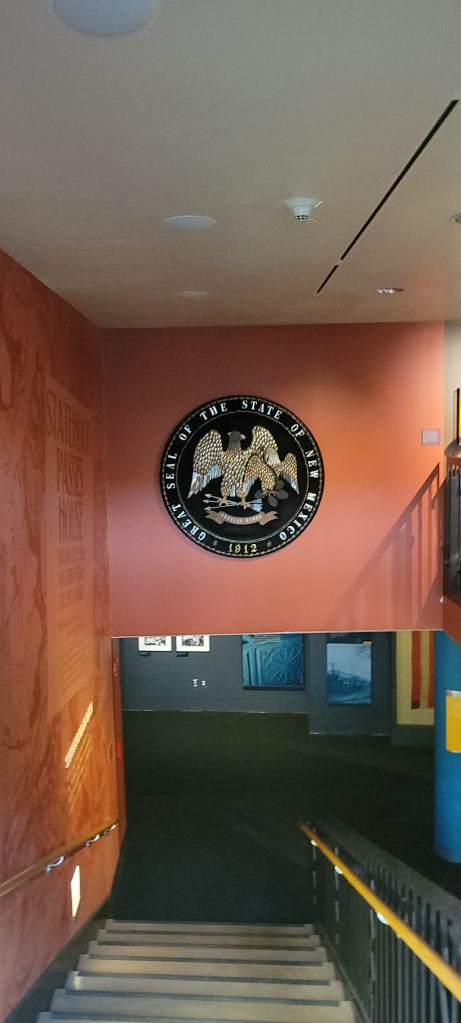
Marvin worked at the museum and had been taking a break sitting in the comfy chairs on the other side of the stairwell. He had seen Julie standing on the steps gazing up at a huge and beautiful rendering of the New Mexico State seal hanging on the wall and had decided that he wanted to help Julie see more than she was able to see on her own.
Marvin came up to Julie and said, “Do you know what that’s made of?” With a hint of excitement and wonder in his voice.
Julie snapped out of her internal jungle gym where she had been pondering exactly that question, but not exactly in the way Marvin meant it.
Julie realized he was asking if she could tell what this particular rendering of the seal was made out of. She looked more closely at it.
“Silver?” She said, still coming out of her internal cloud and not quite attentive enough yet to really answer the question. The eagle on the seal’s chest was clearly made out of something silver.
”Look closer.” Marvin said. Just as he said what they were, Julie’s eyes came into focus and realized what they were, “Those are spoons.” Marvin revealed with giddiness. The eagle’s chest was made out of the bent back and rounded heads of spoons. Marvin continued with enthusiasm. “And the wings. Look at the wings. Those are knives.” Julie followed along. For the next 5 minutes, Marvin went through every single feature in the seal pointing out the creatively repurposed material that made up this piece of art. “And the snake in the smaller bird’s beak, that is a whip.” Julie’s eyes worked to catch up as he danced around the seal. “You see that circle around the edge.” Julie looked closer and saw what they were as Marvin said, “Those are keys.” Detail by detail he had gone through every single item on that seal and said, “I think that’s it. I think I covered it all.”
Julie wasn’t sure which she was more dazzled by, the creativity and resourcefulness in the seal, or the excitement Marvin had for sharing about it.
After the conversation of the seal was done, Marvin was eager to keep chatting. It turns out he was a retired art professor. If Julie had wrote it all down right after talking with Marvin, she might have retained more of the details. What she knew was that he had his hand in all kinds of art. A metalworker, a woodworker and a musician too.
”I have been blessed with many talents.” Marvin proclaimed with a proud ownership that was somehow still dripping with humility as it was encased in pure gratitude and joy.
The conversation flowed through all manner of life. Marvin had inquired where Julie was from and the conversation of seasons and snow came up. Julie had mentioned at one point how she loved the winter back home, though lots of folks in her town spent most of the winter complaining about it.
”Some folks just like to complain.” Marvin said.
”I live 30 miles away. So I commute 60 miles every day. And every morning, I start my day with prayers.” He said it all with beaming pride. “I start my day with prayers and gratitude for all of my blessings.”
Marvin had a twinkle in his eye. It was so present, Julie couldn’t help but mention it as Marvin continued telling Julie about all the ways he kept himself right from the inside out.
“You do have a glow about you, Marvin.”
“Thank you!” Marvin said with that glow fully intact. “I start everyday with a prayer.”
The conversation carried on and Julie found it difficult to stop chating with Marvin even as her ever present clock was lingering in the back of her mind. Everything Marvin had to say was worth listening to and Marvin was just as curious about Julie as he was interested and willing to share about his own life.
“Did you get a picture of it?” Marvin had asked about the seal that started the whole conversation.
“I did.” Julie said, having snapped a shot at the top of the stairs before she had met Marvin and been introduced to the details of what made this seal so worthy of closer inspection. Only later, after leaving, did she realize she had been so enchanted by Marvin’s glow and his enthusiasm to share about the seal and about life, that she had forgotten to get an up close picture in which all of these details could be clearly seen.
Julie learned a lot from Marvin. It turns out, sometimes when you look closer and see the details of what something is made of, even if what it is made of are things that are not inherently beautiful on their own, they can be put together in such a way that they make something beautiful. And when you are willing to look closely, it is a beauty that is not ignorant of what it is made of, but comes directly out of it. Even if what it is made out of are parts that might be purely utilitarian or even downright ugly on their own, they can come together to make something special. It is worth looking up close to see what goes into it. And it is worth stepping back to see what it all comes together to be and maybe even hopeful of what might be able to be created in the future out of the parts that remain. Marvin showed Julie that there is something special just in the act of looking closer and Julie left the museum happier to be doing so – even when the ingredients in the picture are not so beautiful, they are worth seeing for what they are, and trying to find the place where they can all fit together and maybe even create a picture worth admiring.

 R and J in the USA
Leave a comment