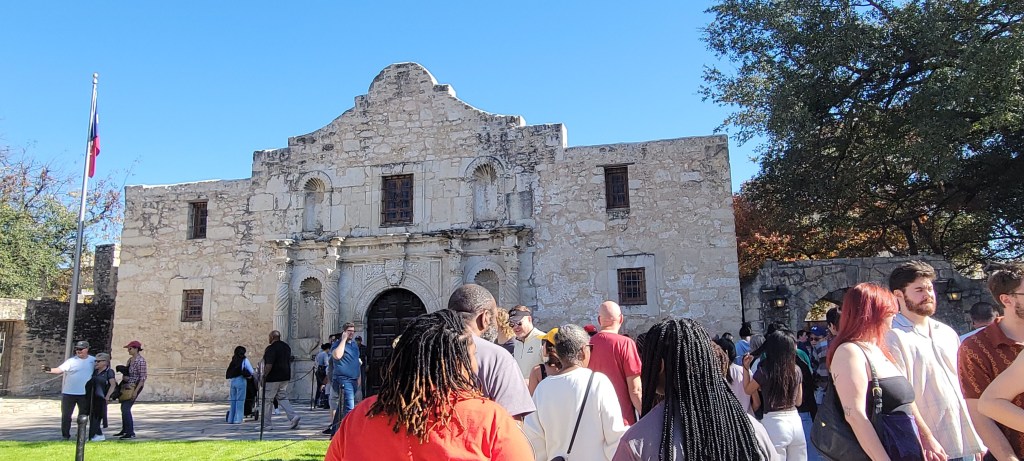
When Julie arrived at the Alamo, she was struck immediately by three separate things.
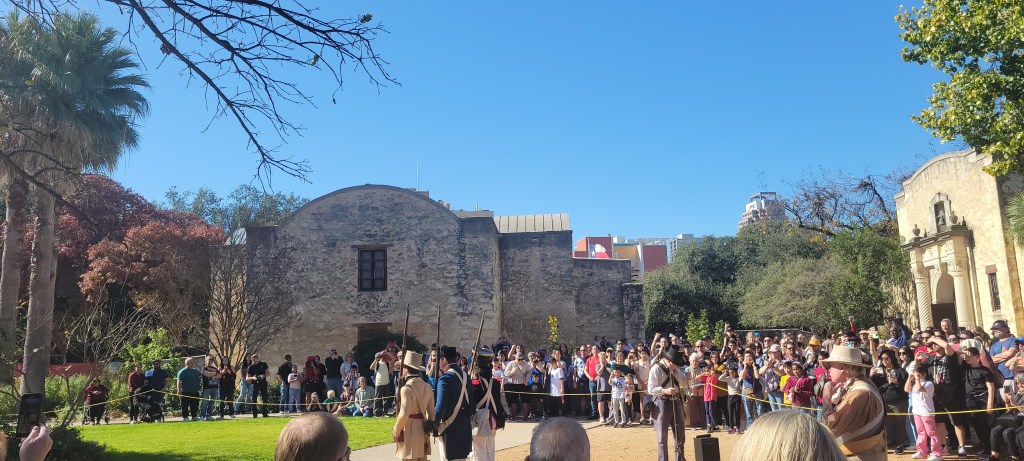
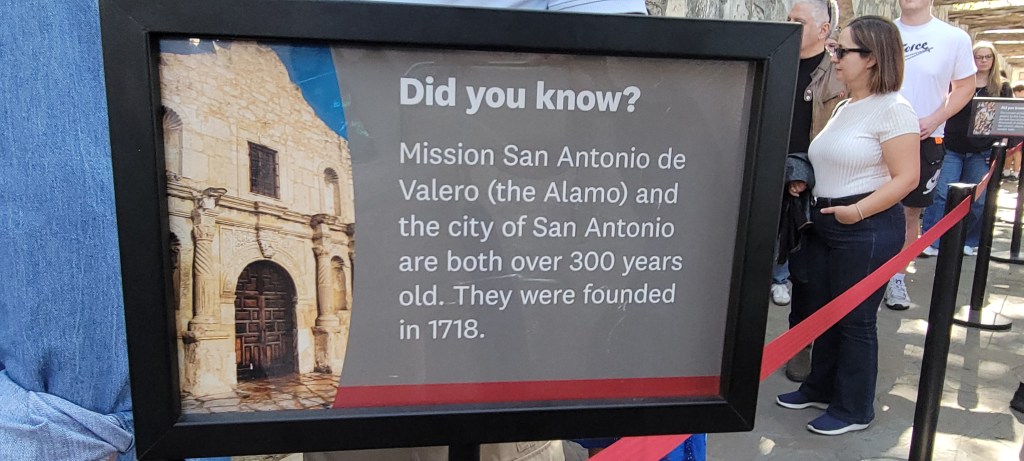
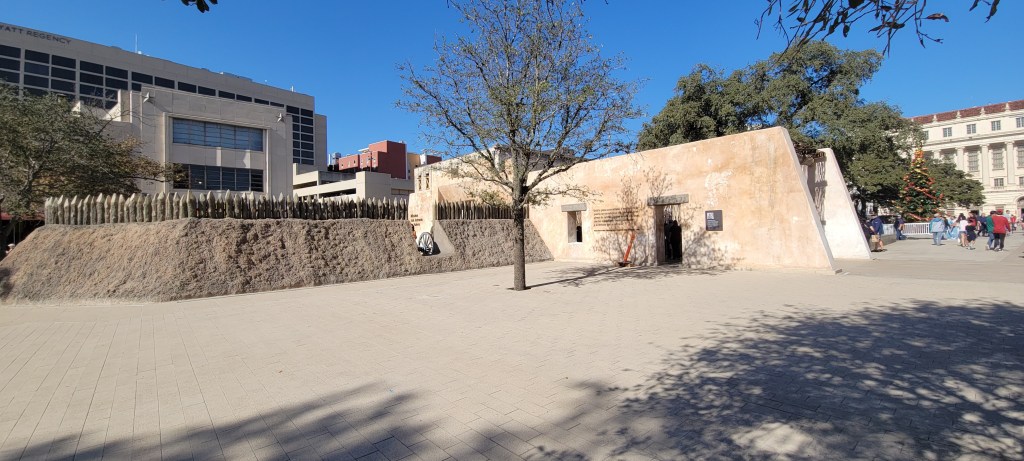
Firstly, she had expected it to be, like so many other historical sites, a piece of history separated out from the modern world, one that you would need to drive outside the main thoroughfares to get to. Not at all. Alamo Plaza was a modern plaza, complete with a huge mall and movie theater just steps from the historic site. The centuries-old site sat like an oasis of history right in the center of the modern hustle and bustle. This was actually pretty neat, as it leant even more to the feeling of the history being present and fully alive. It seemed to lend a deep dimensionality and ease to the task of “Remembering the Alamo”. The Alamo wasn’t a piece of history set aside for only historians and history buffs to make their way to, it was in sight and top of mind. The contrast between the modern architecture and the Alamo made it all the more striking when the historic buildings came into view.
That leads to the second thing that struck Julie. When Julie rounded the corner and saw those buildings for the first time, right there in the plaza, the sight of them nearly knocked her back a step. It’s hard to describe the feeling when one sees something that elicits a deep and visceral feeling, other than to just say that it did. The visceral feeling itself is hard to describe. We had encountered that experience many times on this trip – where you look at something and it absolutely occupies your field of vision and in a way that stirs something inside of you that comes as a surprise and that you realize would be hard to access any other way. We got that feeling standing on Liberty Island taking in the view of the Statue of Liberty. No matter how many times and from how many angles we’ve seen it, it surprises and elicits something powerful each time. Taking in the view of Delicate Arch in Arches National Park or the Grand Canyon did the same thing. You would take your eyes off of them for a mere second and then turn back to look at it and it would hit you again. So it was at the Alamo, seeing the Mission Church. Every time Julie looked up at it, she was awash in something that she would be hard-pressed to find words for other than that it was powerful. The history of it is kept so alive and means so much, especially to Texans, that you almost feel like you are watching the siege of it invisibly playing out in the square these many years later. The building seems to radiate that spirit of defiance and bravery and something else that Julie didn’t have words to express.
Then there was the third thing that struck Julie – she didn’t know anything about Texas history really at all. She knew it was important to remember the Alamo. She knew the Alamo had been seiged. But that was about it. She didn’t know who was doing the seiging and why. She didn’t know the story of Texas or the Republic of Texas or who Sam Houston was or what he did. She didn’t know that he was the general that cried out to his 800 men in the surprise attack at San Jacinto that would happen soon after the Alamo was overtaken, “Remember the Alamo” as he led them to turn and charge the Mexican Army in a fight for their independence from what had become a no longer freedom loving government (despite having recently fought for their own independence from Spain). She didn’t know it was a battle that was over in 18 minutes. She didn’t know that one of the reasons Texas wanted freedom and independence was that they wanted the freedom to enslave others (a concept that Julie struggles to wrap her mind around how one can hold such a thought in mind as a coherent one). She didn’t know so much about the history of Texas and felt like she was drinking water in a desert of her own ignorance. Everything she learned made her understand more and more what makes Texas what it is and who it is today and only lite the flame brighter in her to want to learn more.

 R and J in the USA
Leave a comment