There were about a dozen of them, sprawled out on the pavement in view of the Alabama state capitol in Montgomery. Some sitting. Some leaning. Some splayed out on their backs. A few of them finding shade from the warm, mid-afternoon sun. It looked like the group we had seen the day before.
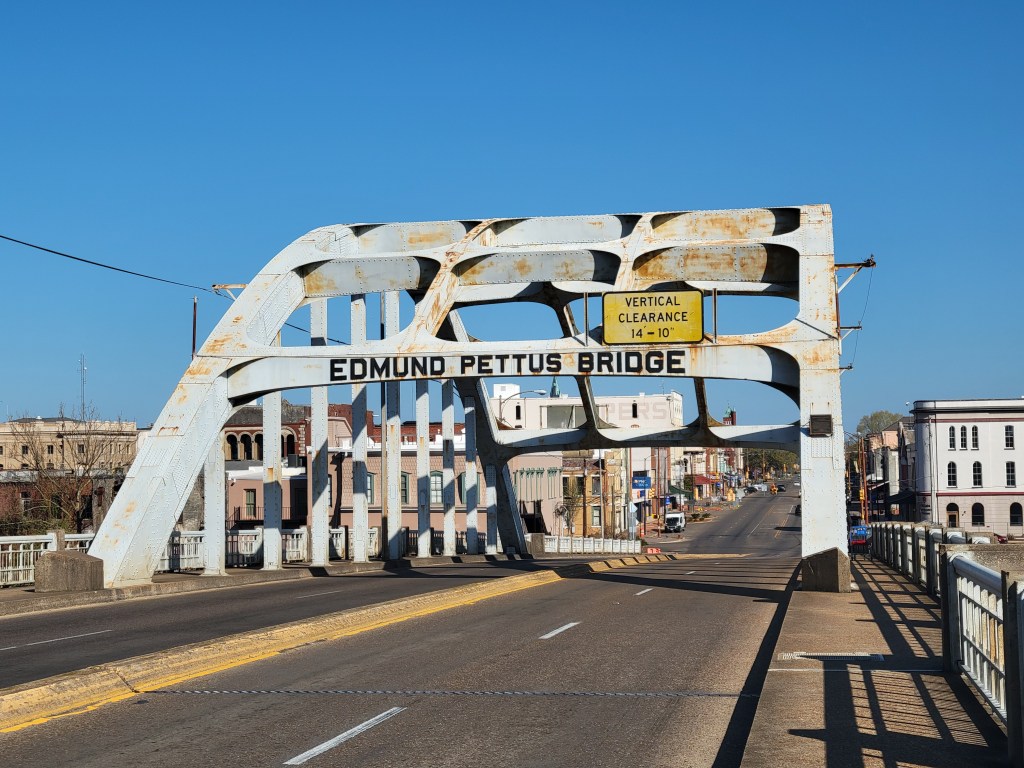
We were driving westward on U.S. Route 80 miles out of Montgomery when we saw them walking in the opposite direction. A loose assemblage. One of them carrying a black marching flag with white block letters on it. Our destination was Selma’s Edmund Pettus Bridge, a placid-looking steel arch bridge with a less than placid history. The site of 1965’s Bloody Sunday, when more than 500 civil rights marchers were brutally beaten back by Alabama state troopers as they attempted to cross the bridge in their march for voting rights for black citizens. The site where, two weeks later, 8,000 people assembled with Martin Luther King, Jr., to begin their 54-mile voting rights march from Selma to the state capitol in Montgomery. The site where the animation and weight of those events endure on the otherwise inanimate structure.
By a coincidence of many interweaving itinerary factors that had us arriving in Alabama later than we’d originally planned, we were driving from Montgomery to Selma on March 21st, 2025. Our knowledge of Civil Rights history was enough to let us know the significance of Selma and of this corridor between it and Montgomery, but not precise enough to know that we would be making our pilgrimage to pay our respects to the place and its significant history on the 60th anniversary of when the march to Montgomery began. And, the next day, we would make the drive from Selma back to Montgomery during that five day span that played out 60 years ago. In our desire to pay our respects and bear witness to this history, we didn’t expect we’d get to bear witness to its commemoration in present times.
Sixty years – to the day – from when that march began, we drove its route. The next day, while Julie was steeped in the exhibits of the past in the state history museum, Ryan saw a group of tired people sprawled out in front of the state capitol where the march had ended.
He approached them to exchange the briefest of pleasantries.
”Are you the people we saw marching from Selma, yesterday?” he inquired.
”Yeah. We did it in two days,” one of them proudly replied as many of the marchers lay in repose.
They came by that rest honestly. They had walked the entire route of the voting rights march to commemorate its 60th anniversary. Black and white. Men and women. Young and middle-aged. One with a leg amputated at the knee. 54 miles in two days under an intense Alabama spring sun they walked. Their fatigue was earned.
The interaction was brief, and closed with mutual pleasantries. Ryan noticed their thirst and thought they could make use of the unopened gallons of water we had in our van from back in Oklahoma, where our water tank temporarily froze for a day or two. Before he retrieved the gallons to offer them up, someone of their group came rolling in with a big cooler to provide refreshment well-earned.
We came to this place of pilgrimage to pay our respects and to witness history. We didn’t expect we’d get to witness it with as much proximity as we got to experience. We were grateful for the synchronicities that landed us here at this particular time. It is something to see that bridge in person. It is something to walk over it with your own feet. It is something to remember and to honor. It is another thing to get to see people marching the miles, 60 years later, and earning their fatigue and pride and camaraderie along the way.
 R and J in the USA
Leave a comment