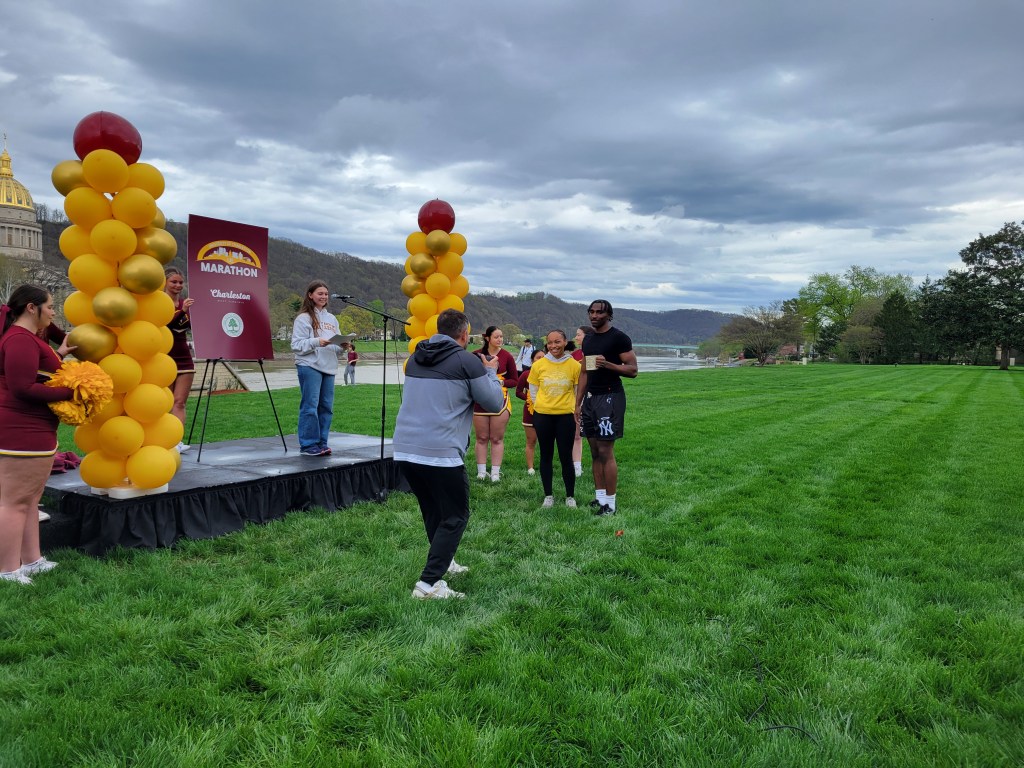
We were walking through the post-race crowd at the finish line of our West Virginia 5K at the University of Charleston when a voice caught our attention.
”Ryan!” Someone called.
We stopped and turned around, curious as to who might be calling Ryan by name. We didn’t know anybody at the race. As a matter of fact, so far as we knew, we didn’t know anyone in the whole state of West Virginia. Who could possibly be calling Ryan out by name?
When we turned around, two young college-aged men that we had never met jogged enthusiastically towards us, towards Ryan specifically, with a look of dialed-in eagerness on their faces.
As these young men arrived in front of us, we greeted them with equally unexpected familiarity.
“Hey!” We said, “ We were just talking about you.”
They seemed just as taken aback to hear we had just been talking about them as we were that they had sought Ryan out by name.
After all, before this moment, none of us had ever spoken a word to each other.
Even so, we were not exactly strangers either.
The secret to how four people that have never met can come to interact with such unlikely familiarity can be found inside the peculiar conditions and circumstances of a running race. These young men were not the first strangers that we have found ourselves coming to know in some small way, with or without words ever being exchanged, over the course of our now 49 5Ks in the prior ten and a half months. It is in the nameless, but not faceless goings on of a shared 3.12 mile journey that these familiarities begin.
The genesis of this particular interaction took shape at about the 1 and a quarter mile point in our race through the neighborhoods around the University of Charleston. The race course included a turn around cone at the half way point. Though the course wandered through many twists and turns among the neighborhoods, the turn-around occurred at the end of one long, flat stretch. This made it so that the frontrunners jogged past the rest of the pack in such a way where we were all visible to each other for a good quarter of a mile. It was easy to get a good look at each other as we approached from opposite sides. It was a long enough time to gather a decent amount of information about each others’ running styles, if that is something someone cared to notice.
It is not uncommon, in a race, for runners to begin to recognize each other. In the adventures that exist between the starting and the finish line, conversations can strike up, friendly rivalries can form, and even friendships can be forged. Sometimes all at once. We have experienced all of these. It is simply part of the race experience. Any shared experience that includes some degree of pain, discomfort, hope, effort and competition is bound to be a place where relationships of all kinds and levels can be forged.
So, even though the four of us were definitely strangers, there was a criss-cross of unspoken, but very real relating that had already occurred and was now, after the race, turning into actual acquaintance and interaction.
Halfway through the race, while Julie had been approaching the turnaround point and the race leaders were passing her by going the other direction, Julie saw that Ryan was in 3rd place. But, what struck Julie was the gentleman that was in second place.
When Julie saw the second place runner go by a hundred yards or so before Ryan, Julie found multiple aspects of the way he was running his race to be noteworthy. Despite the fact that he was solidly in second place at this race midpoint with Ryan a good hundred yards behind him, as he passed by, Julie found herself thinking, “Things being as they are, I think Ryan is going to overtake this guy before the finish line.”
What would make Julie make such a snap judgement in the space of maybe 15 seconds of viewing? It was the same thing that made Ryan, from a hundred yards back, suspecting the same thing from his vantage point.
One thing that is an unintended consequence of running almost 50 5Ks in ten and a half months and plenty of years of running that preceded this, was that both Julie and Ryan had naturally started to become observant of the other runners. Part of this was strategic in managing our own runs, and part of it was just a niche version of entertaining people-watching.
To understand what gave us the same thought and conclusion in the middle of the race despite never being able to speak with each other about it, it is necessary to understand a little bit about 5K running. Those who are runners may already have a sense of some of the things we might have been noticing that led us to both reach this conclusion about someone that was clearly a fast-runner.
As with any endeavor done with regularity over time, when you do enough of it, you can develop an ability to notice little things that give you greater insights into where someone is coming from and what they might be able to put out onto the table. People are always full of surprises, of course, but when you run a lot of races, you can develop a good eye for who is a runner and who is not a runner. You can usually get a sense, right at the beginning of the race, who is going to hold their pace and be able to speed up over the course, or who will burn out and eventually slow down.
To understand how we both reached this conclusion mid-race, it is helpful to know some of the details of what you might observe as runners pass by or fall behind along the course.
First and foremost, you can tell a decent amount about the runner by the look of their running gait. You can see in their overall form the degree to which they have control over their body and their limbs as they take their steps.
Secondly, the way they are breathing can sometimes tell you a lot. When you are running behind someone that is holding a faster pace than you, but with loud and huffing breaths while you are progressing in an easy-breathing effort, you can be pretty sure that, as the miles progress, you will eventually overtake them. Much of this is simple physiology and math. But, anything that is human in nature is never an exact science and sometimes this rule does not hold. In one race, Ryan was passed mid-race by a woman in her 50’s that was huffing and puffing like she was giving her last few drops of effort. He was sure she would eventually fall back and that he would eventually pass her with so much of the race left to go. Ryan didn’t even see her again for the duration of the race, let alone pass her.
Sometimes you can gather a decent amount of information from someone’s build, though that is the least reliable piece of input. There are all sorts of body types that finish strong in races. That said, the really strong, elite runners tend to have a long and lean shape to them. Most of the people that cross the finish line on the podium tend to have that lean build, but that isn’t always the case. In this particular race, the gentleman who took and held first place for the duration of the race had an atypical runner’s build with broad shoulders and a thick, muscular shape. He was clearly strong, and even though he didn’t have the lean muscle look that is typical of high level runners, he ran with every bit as much speed and adeptness.
One of the most reliable pieces of observable input that starts to form the picture is how effortful a runner appears to be. If someone looks like they are running, rather than jogging, it usually isn’t going to last long. It is amazing how casual the front runners look. At first glance, just to look at them, it barely looks like they are moving fast, because they seem so relaxed and easy. In truth, they are simply running with efficiency and at a pace that they already know they are fully equipped in cardio and fitness to sustain. It is only when you realize how quickly they are covering ground and how swiftly the scenery is moving away behind them, that you realize, wow, they are trucking.
And, perhaps, the most consistently indicative factor of whether the runner you are looking at is going to deliver on an early fast pace and cross the finish line looking every bit as in control as they did in the first few steps, is the look of focus on their face. A runner that knows what they are doing looks like they know what they are doing. They are absolutely locked in and focused on running their race and nothing else. Their gaze is typically straight ahead and the emotion on their face is often blank as they conserve every ounce of energy to put into their forward motion – using all of that focus to manage their gait, their pacing, their form and whatever amount of pain they might be enduring to maintain the pace they have chosen to run. Frontrunners rarely avert their gaze from the 100 yards in front of them that they are barreling towards.
All of these factors, but especially the latter, is what caught Julie as she passed by the race leaders near the midway turnaround point. The first place runner, other than his more muscular than typical build, put a check mark by each of these things as he blazed by in a cloud of pure focus. And Ryan, coming through in 3rd checked almost all of the boxes, except of course his temporary melting of his otherwise dialed in focus to reach out to give a low five to Julie as we passed by in opposite directions. But, even then, Ryan never broke his concentration. Despite the low-five he delivered, as he passed his wife, his gaze didn’t break from right in front of him, and his face remained emotionless and focused on maintaining his speed.
But the gentleman in 2nd place really caught Julie by surprise. At first, she thought that he was not a racer at all, but someone working for the race and hopping in to jog a bit and cheer everyone on, because that is exactly what he was doing. It was really nice and Julie felt buoyed by his genuine and supportive encouragement that he offered to all of us at the back of the race. He called out, “Great work” to every runner as he passed us. It was lovely. But, it was not typical of the energy conservation and focus that keeps someone competitive and holding onto a podium finish.
It also struck Julie to see him in second place because, though he was clearly strong and clearly an athlete, he ran with the form of a casual or amateur runner, running tired and a little hunched, like he was falling downward into the ground with each step making it seem that, with each step, he’d have to use some of his energy to regain and rebuild that upward and forward momentum against his own form. Strong runners often have a look of pure forward motion with their shoulders, hips and head all lined up facing forward. Meanwhile, their legs, knees and feet navigate the work of interfacing with the earth beneath them as they continuously capitalize on the most recent spring of their last foot strike to continue them barreling ahead.
Julie found herself reaching a conclusion that this guy was not a runner at all, probably an athlete in another sport. Julie also found herself thinking, this guy is so good as an athlete that, without any of the things that make runners good runners, he is still in second place and running a fast time. He didn’t look like he was running fast at all, which is usually a good sign. But, for him, it wasn’t because he was making it look easy, it was because he was making it look hard, like those of us further back in the race.
It turns out, Ryan had been noticing a lot of the same things out on the race course and had been fairly confident that he would eventually be able to claim the second place spot in the race, which he did.
When Ryan did catch up to him, he noticed something else unique. Oftentimes, when someone is running and clearly working hard to do it, when someone comes from behind and begins to overtake them, they surrender fairly quickly and let the pass happen. The reason for this is, if they are already working hard and someone starts gaining on them, especially if there is distance ahead to go, an experienced runner will know that conserving their energy to do the best they can do for the rest of the race is worth more than burning out early trying to stay ahead of someone that clearly has more left in the tank than you. But this guy was different and Ryan was impressed by his spirit and his hunger. Ryan approached him with a focused, easy and steady pace. Ryan was managing his race well and, though he was working, he was working at a level that was easy for him to maintain and continue to deliver on. When he caught up to the young man in second place, this guy did NOT want to surrender his position and he picked up the pace to stay with Ryan as long as he could hold out, maybe 15 or 20 seconds. This doesn’t sound like a lot, but when you are working hard with a couple of miles already underneath you, it is.
Eventually Ryan passed him, but he did so having taken note of this person more so than people we typically notice in races.
After each race, when we meet up at the finish line, we typically enjoy a post-race cool down walk while we share our race reports with each other that eventually gets turned into our “Detailed Race Report for Running Nerds” that we include in each of our 5K blog posts. Our race reports include all the details of each of our 3.12 miles. It usually includes how we felt physically, where our mental focus was at and our race strategy and how it panned out. We often include any interesting stories that occured along the course and that oftentimes includes any mini race rivalries or interesting observations we made during the race.
In this race report, we both found ourselves having a disproportionate amount to say about the fellow that had been in second place before Ryan claimed that spot. We also included commentary on the fellow that had been running behind Ryan in fourth place at the midpoint as he had many similar qualities.
It was these two young men that were approaching us after the race and calling out Ryan by name. We had just been talking about them, despite not yet knowing their names and, the fact that they had already gone to look to find the name of the second place finisher so they could call him out by name and grab his attention. This was an indicator to us that they had been talking about Ryan with every bit as much interest.
Jacorey was the fellow that Ryan had passed. He still managed to claim 3rd place overall in the 5K and his friend, Makao, had managed to hold on enough to claim a 5th place finish.
As they approached to talk to us, whatever look of determined focus we didn’t notice on their faces during the run would have been absolutely eclipsed by the look on their faces now.
We had already found our unspoken encounters with Jacorey and Makao interesting enough to chat about right after the race. What happened next has sparked our interest and inspiration so much more that we still find ourselves chatting about them days later.
”I have to know how you beat me.” Jacorey said with a smile and a hunger in his eye. He had a mix of enthusiasm, friendliness and that driven look that we recognize, especially Julie. That look of primal hunger and ambition and drive.
”You gotta give me some tips.” He pressed.
This man had not wanted Ryan to beat him. But when Ryan did, Jacorey did not just sit around and lick his wounds. He went out of his way to find the name of the person that bested him to track him down and to get advice on how he could improve himself for next time.
Immediately, we were impressed.
We then started to pour out everything we had just been saying. Jacorey and Makao were locked in as we rambled on about training, pacing and running form. They were focused and soaking it all up.
They clearly did not come to get any tips from Julie who, as you can read in our detailed race reports, is now officially in overtrained mode and not doing any kind of impressive running anymore and even on her best day, can’t hold a candle to Ryan. None of this deterred Julie from adding in her two cents, of course.
Ryan repeated over and over, “You’ve got the speed and the talent and once you dial in some of these other things, you are going to be cruising.”
Julie echoed it, “Yup, if you learn these other pieces, there is no way Ryan would beat you!”
As the conversation continued, the pieces all fit together. Jacorey and Makao were indeed both athletes playing competitively on their university teams – Jacorey, basketball and Makao, football. And neither of them were runners. So much so that, not only had they never run a 5K before, but they came to run this race when they saw it advertised the day before the race and said, “Hey, how hard can it be? Let’s do it.” Neither of them had any physical experience of how long a 5K actually is and were both surprised that it was longer than they had imagined. So, they had done zero training, had never really run any distance before and had never run in a race at all. And with essentially no experience behind them, they came in 3rd and 5th place overall respectively. Not too shabby. It wasn’t the fastest of fields we have run in – no one broke 20 minutes and, if Julie was in the shape she was in at the beginning of our 50 states tour, she would have taken 4th place overall herself (though she is not even CLOSE to in that shape anymore), but, still, 3rd and 5th place for your very first 5K ever is pretty darn good.
After the conversation was done and Jacorey and Makao had gotten the tips they wanted to get, we found ourselves still compelled to talk about them, but this time for a different reason.
”Now that is what success in the making looks like,” Julie said to Ryan as we walked away.
And this isn’t just because they clearly had the raw speed and talent to be good runners.
”That young man just came in 3rd place, which is pretty good, but he was so hungry to win at something that isn’t even his main thing, that he looked up the race results, found your name, tracked you down and came up to the man that beat him and said, ‘Teach me tips. How’d you do it?’”
Ryan laughed in acknowledgement and agreement, “You’re right.”
”Now THAT is damn impressive.” Julie continued before finding herself launching into a monologue of reflection on all that these young men displayed of their character.
“I think there are three things that make a person successful at whatever it is they choose to do, especially if what they are doing is competitive in nature and those guys are cruising on all three. One – you gotta have that drive and that hunger, which usually means you hate the feeling of failing, falling short on your goal, or, if it’s a competition, being beat. You gotta like winning and succeeding, but you gotta hate failing and losing even more. There is no question those guys had that.”
“Two”, Julie continued in a blaze of inspiration by what Jacorey and Makao had just modeled, “- you gotta own that it’s completely on you whether you succeed or fail at what you are aiming for – no fingers to point, no excuses to make, it’s on you to do it and if you don’t do it, it’s on you to fix it. Again, they had that in spades.“
“And three – well, you can sum up three easily, you gotta have the audacity and the hunger and the humility to run up to the guy that beat you and ask him how he did it! And then ask him for some tips! Another way to say this is, you gotta look at every failure like a stepping stone on the path to your inevitable and eventual success and milk everything out of it to help you learn and grow and develop. That means being willing to look at what you did or didn’t do right or well or enough – no ego, no shame, no insecurity – there is no time to waste on any of that. You gotta be so focused on getting better that you don’t have time to waste in any of that silliness, or if it’s there, you get over it quickly enough to go chase after the improvement and get busy getting better. That means looking around and seeing the people who are doing, successfully, what you are wanting to do successfully and trying to learn from them what you can. That means having the audacity, the boldness and the confidence to walk right up to them and ask them to teach you what they know. And, hot damn, did they do that. Those boys just showed us what success in the making looks like.”
When Julie’s little success monologue was done, Ryan was laughing and nodding in full agreement. We were both equally impressed and elevated by the role modeling that Jacorey and Makao just showed us.
After the race awards ceremony it was us chasing them down to ask if we could grab a picture and write about them on our blog.
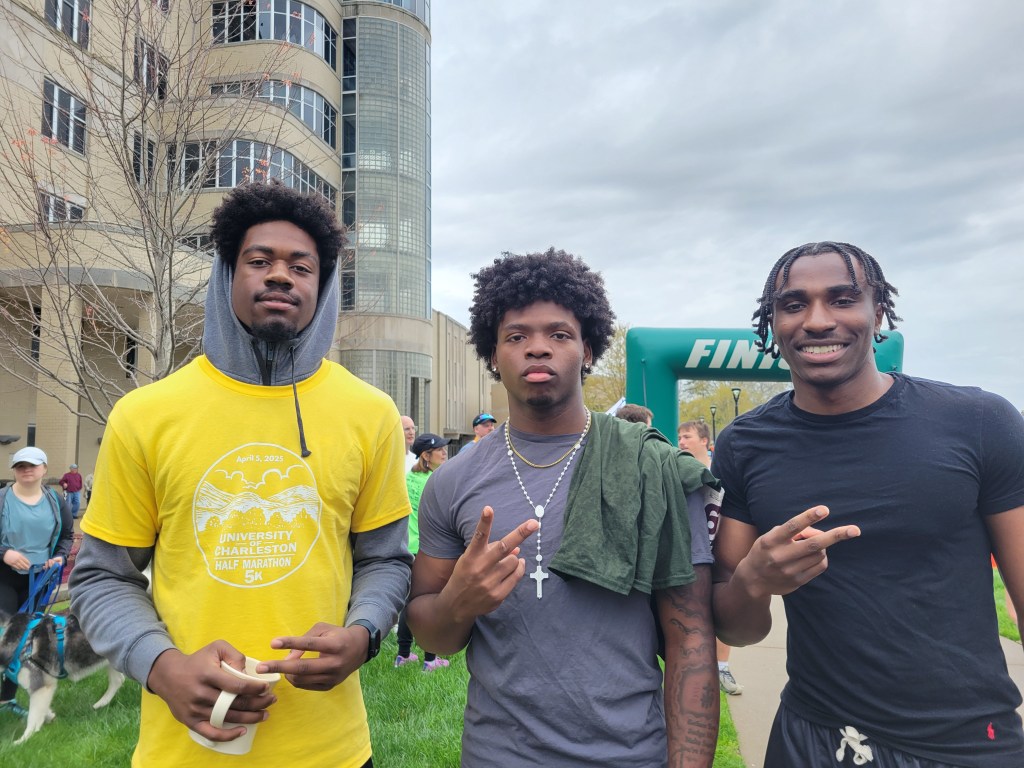
We even found ourselves, days later having spontaneous thoughts of different aspects of what made that little action so remarkable.
“They are not even runners.” Ryan proclaimed out of the blue while driving through the middle of West Virginia days later. “Most people who are not runners don’t look at running and recognize that there are layers to it. They just look at someone who beats them and think, that person is faster than me. Full stop. Just the fact that, as someone who has never really run before, he knew that there was more to it than just speed, just the fact that he thought to be curious about what made someone able to run a faster race and that he thought to ask to learn what could make him faster…just that alone is impressive.”
Suffice it to say, we felt we learned a lot from Jacorey and Makao – maybe more than they learned from us. They had come up to ask Ryan for a little mentorship, but we walked away feeling like we were the ones that got the schooling.
So, now we are keeping our eyes out for the names Jacorey and Makao. If they keep their curiosity to learn in full form, their hunger strong, their hearts lifted, and their spirits bold the way we saw at that race, we are willing to bet on them. Whether we end up seeing them on the world stage one day or not, we are quite confident that, whatever they choose to do in this world, they are going to do it well.
 R and J in the USA
Leave a comment