April 13, 2025
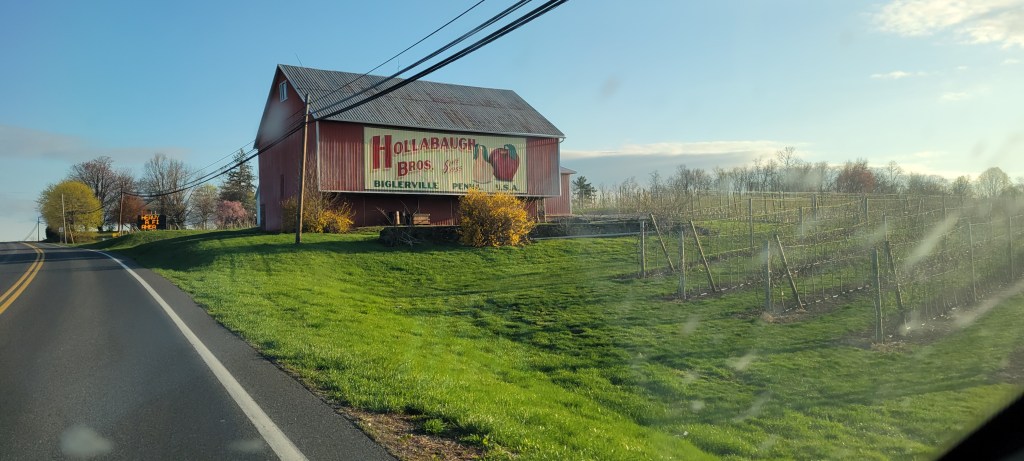
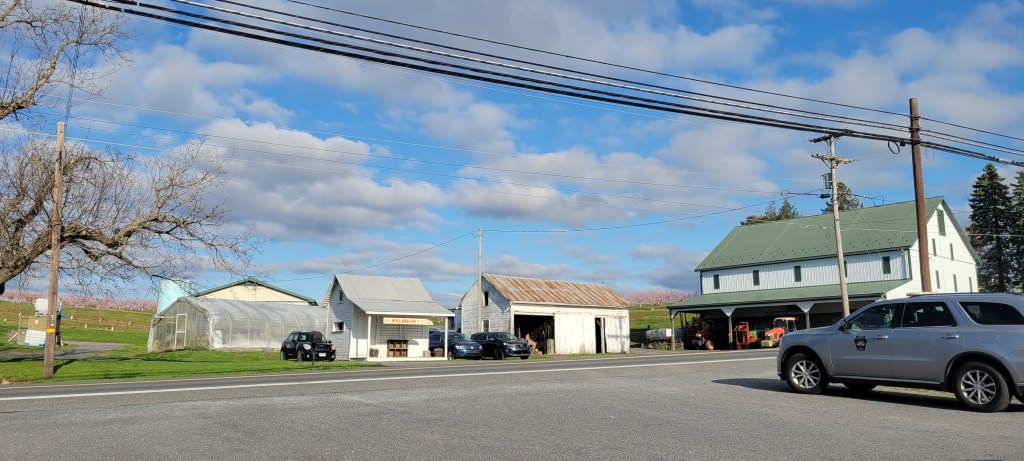
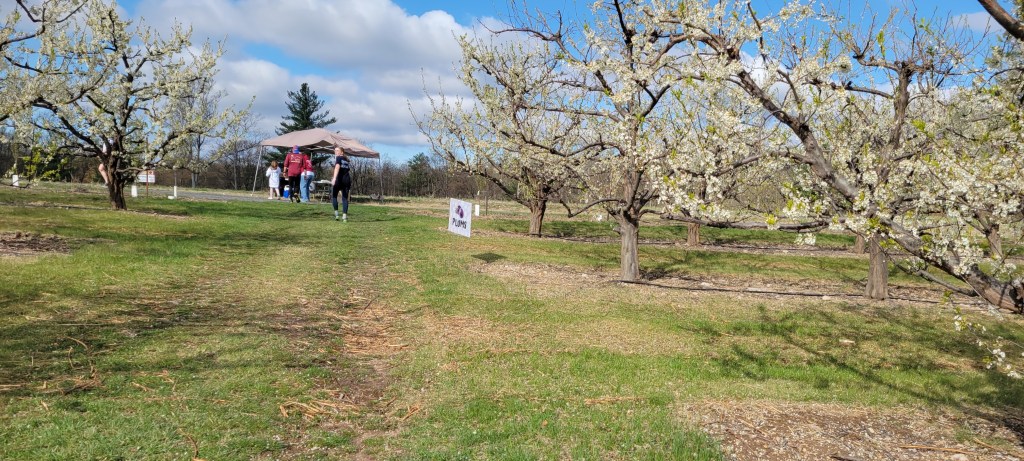
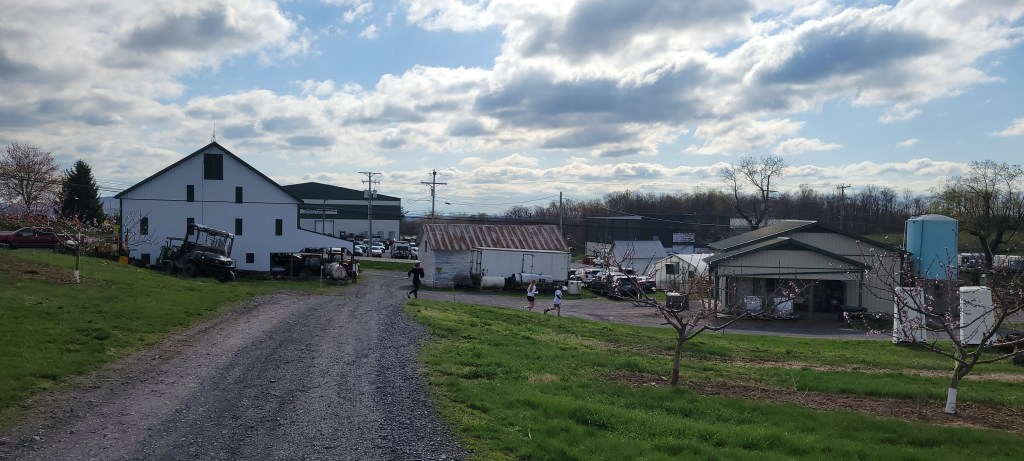
The road to the Hollabaugh Brothers Fruit Farm and Market in Biglerville wound through hilly southern Pennsylvania farm country. Driving north out of Gettysburg under a sunny Sunday morning sky, we landed amidst a complex of buildings surrounded by the orchards of the 4th generation Hollabaugh family farm. What we found there was perhaps more striking than the orchards in bloom amidst the hills beyond.
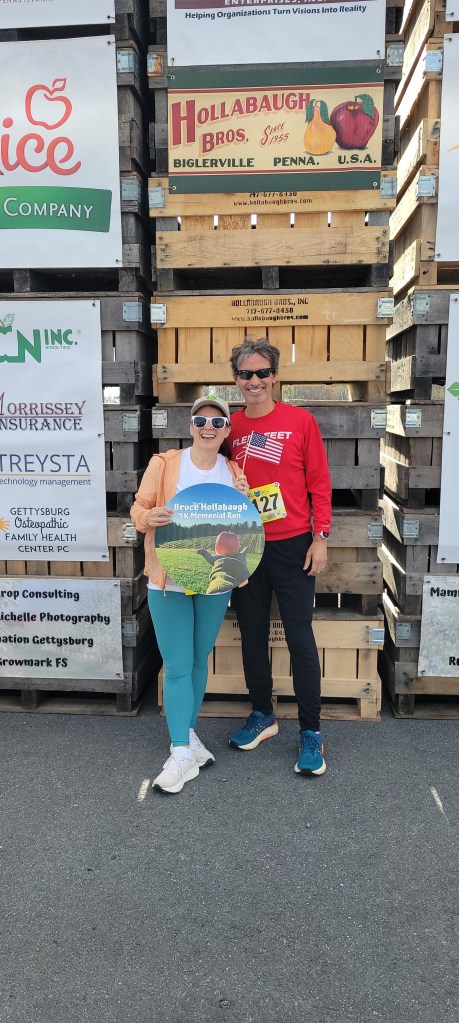
We were there to run the inaugural Bruce Hollabaugh 5K Memorial Run. The race honored Bruce Hollabaugh, production manager and 3rd generation family farmer, who passed away in 2022. Part of the farm’s yearlong 70th anniversary celebration, the race benefits the Bruce A. Hollabaugh Memorial Endowment Fund, which Bruce’s parents created to support charities and community initiatives for which he cared deeply during his life.
We have participated in multiple memorial races on this trip, each of which celebrated a person who enough people cared about enough to memorialize, and many of which raised funds for causes in their honoree’s name. This event did those things as well, but it did them in a different way. It reflected a life rather than commemorate a death.
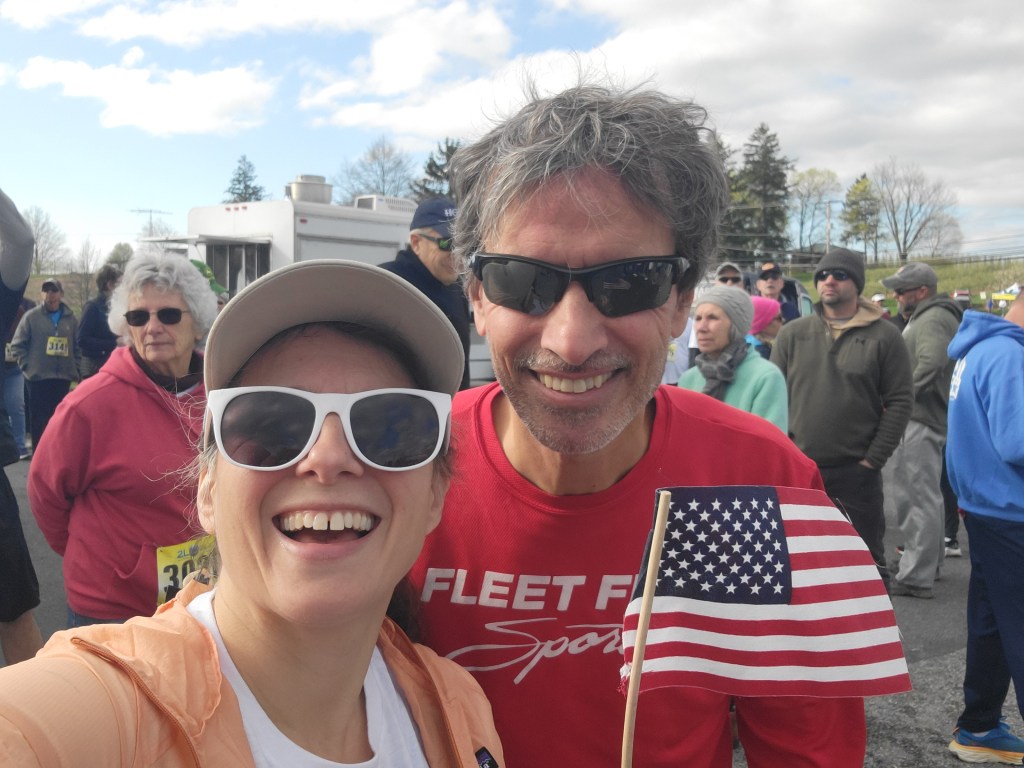
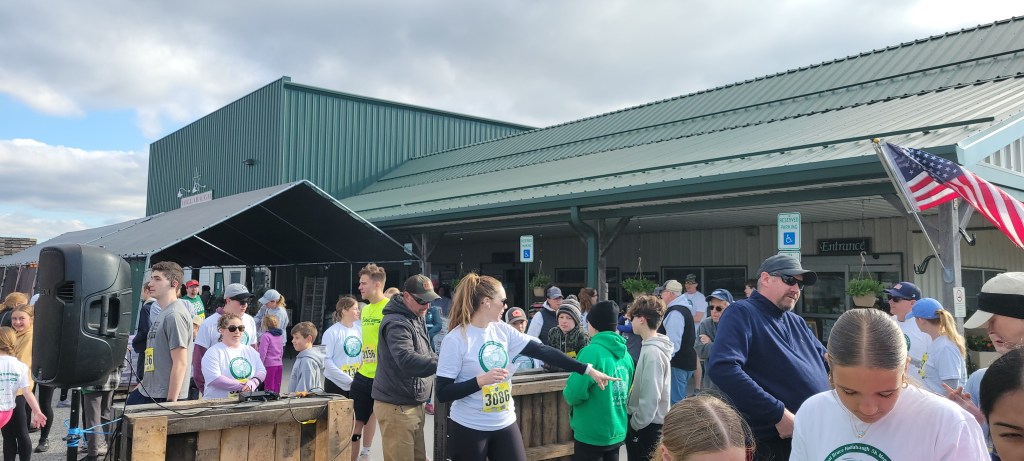
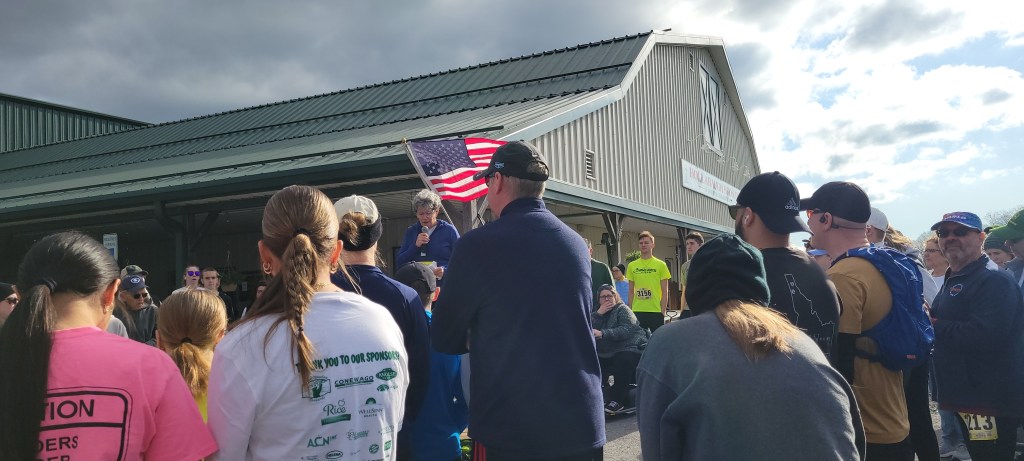
The event felt like a large family of relatives, friends, neighbors, and colleagues anchored by a farm intertwined with the surrounding community were all gathered on that farm for a celebration in which the honoree happened to not be there. We seemed to be among few people who did not know Bruce or his family, yet we felt like invited guests, and we felt like we gained an appreciation of Bruce by the fact and form of the gathering.
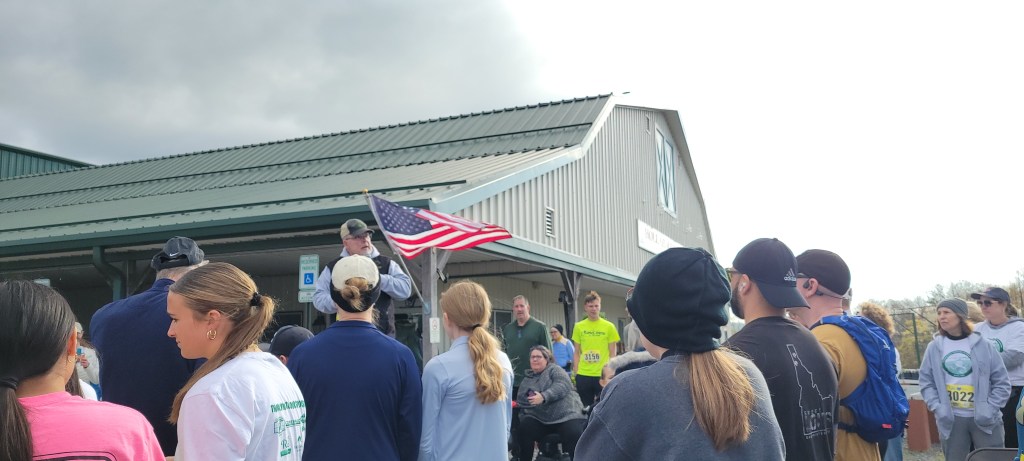
Bruce’s parents both gave heartfelt and touching pre-race remarks. Yet their remarks, and those of others, were the least of what the event communicated about Bruce. To our strangers’ eyes, our impression of Bruce was shaped not by what people said, but by what they did and how they did it – and by who they were.
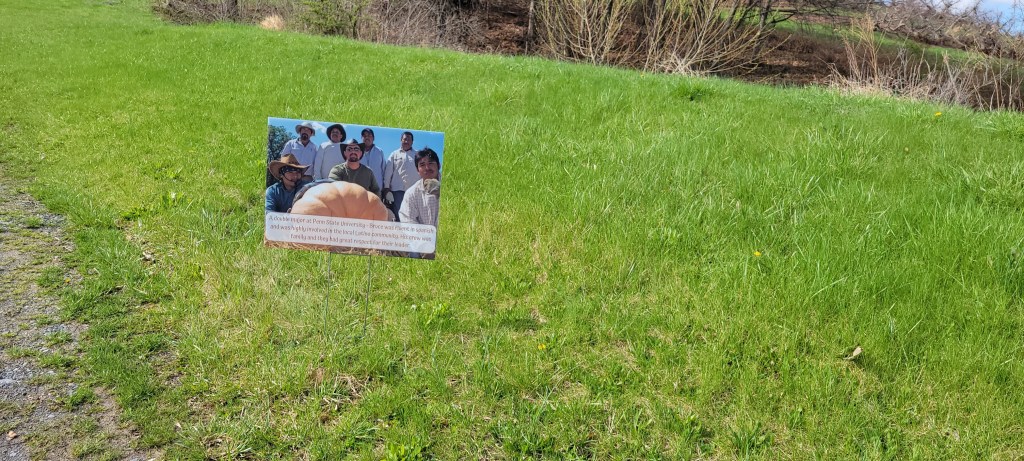
Bruce’s mother, father, wife, and several of his children participated in the race, underscoring the binding tie of running through the generations of their family. Participant gift bag items reflected the farm he managed. The course map and description detailed ten specific plots of orchard traversed by the 5K and described Bruce’s role in planning, managing, and experimenting with those plots. Placards with QR codes were placed along the course. Those walking the course could scan the QR codes to learn about various aspects of Bruce’s life and interests. And, perhaps greatest of all, people showed up for him – so many that they had to cap the race registration. 217 people traversed the 5K, and perhaps half again as many came to be part of the event.
These efforts gave us an image of Bruce beyond what words alone might convey. That this extended family and community was willing to put forth such efforts conveyed perhaps even more. These were sincere, capable people who seem to be assets to their community. That so many people of such caliber created such an event and came together so beautifully to honor a person makes perhaps the biggest statement of all about Bruce and the extended family and community from which he came.
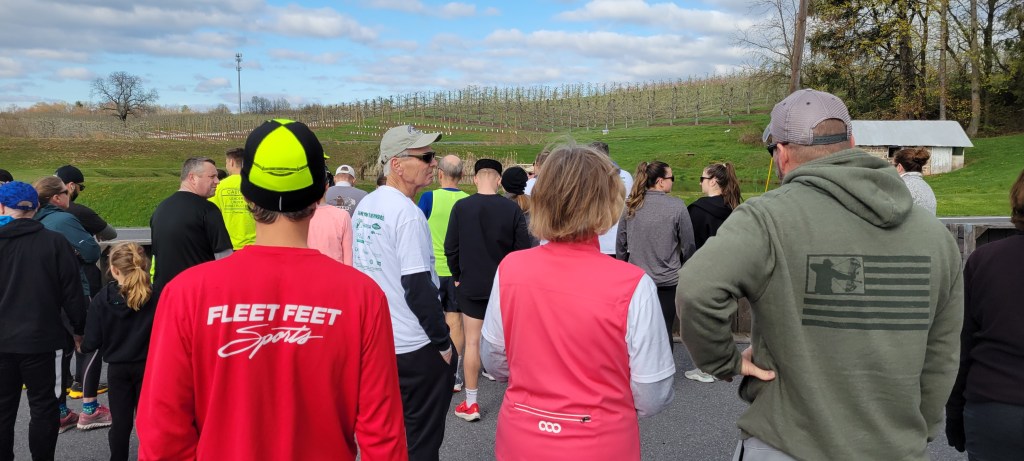
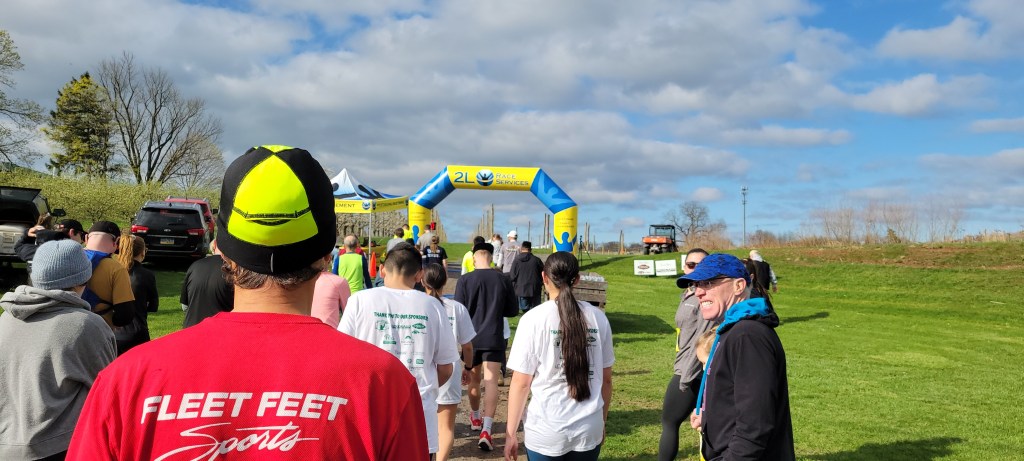
Through it all, the prevailing atmosphere was positivity and joy, and it was in this atmosphere that 217 people stepped up to the starting line.
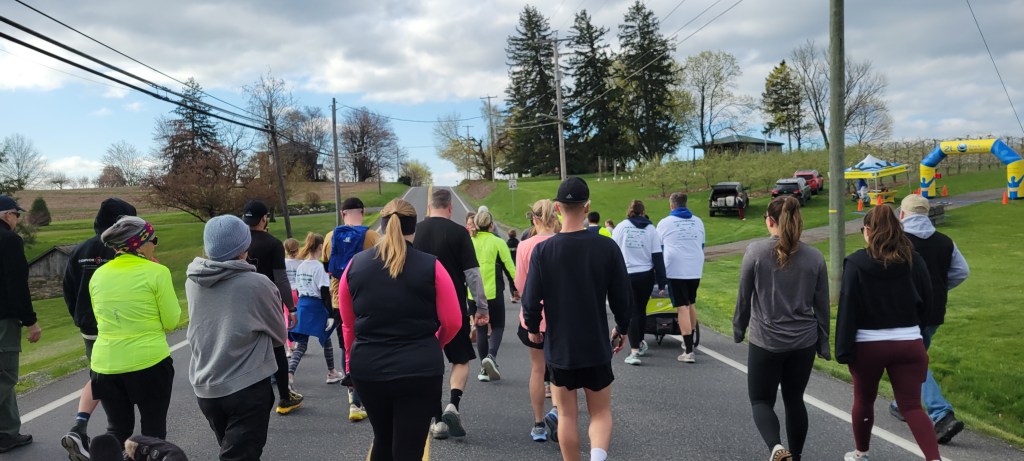
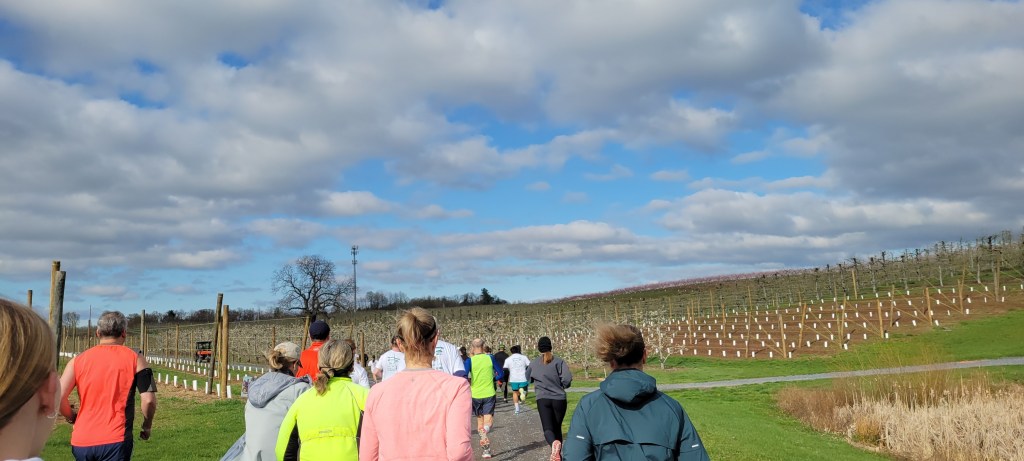
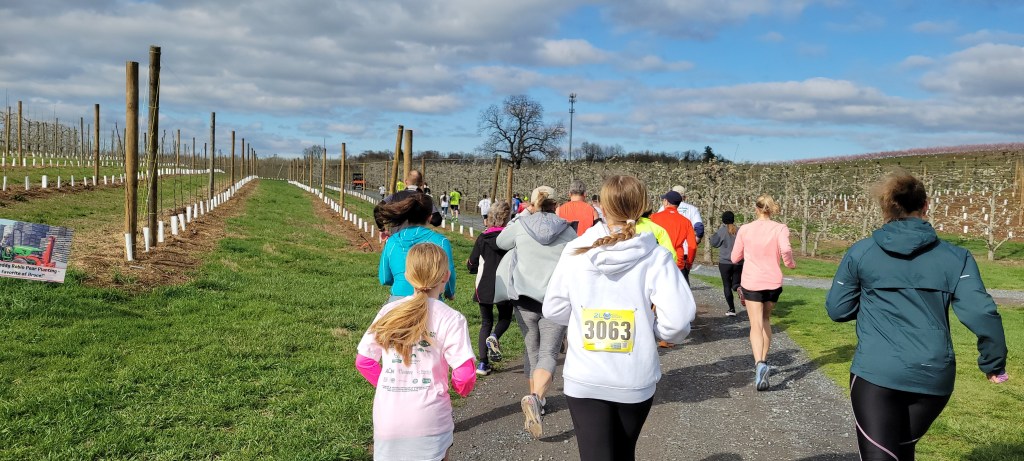
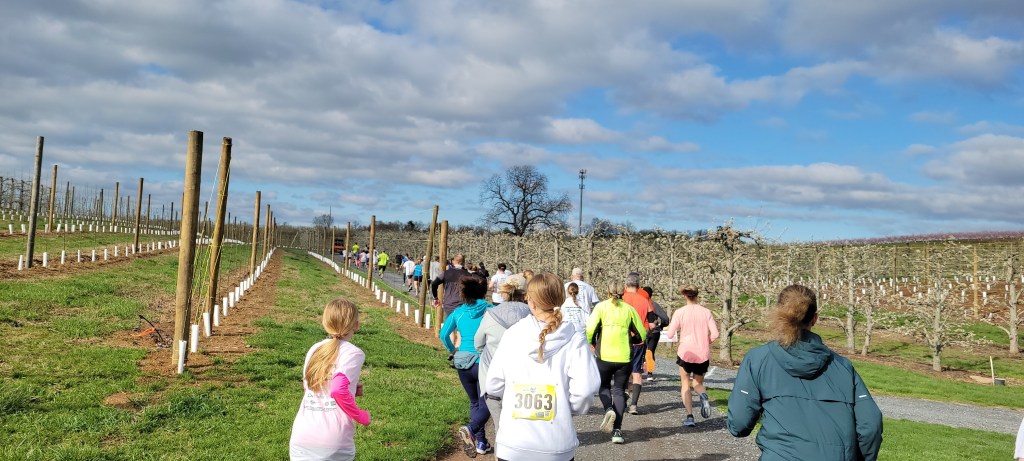
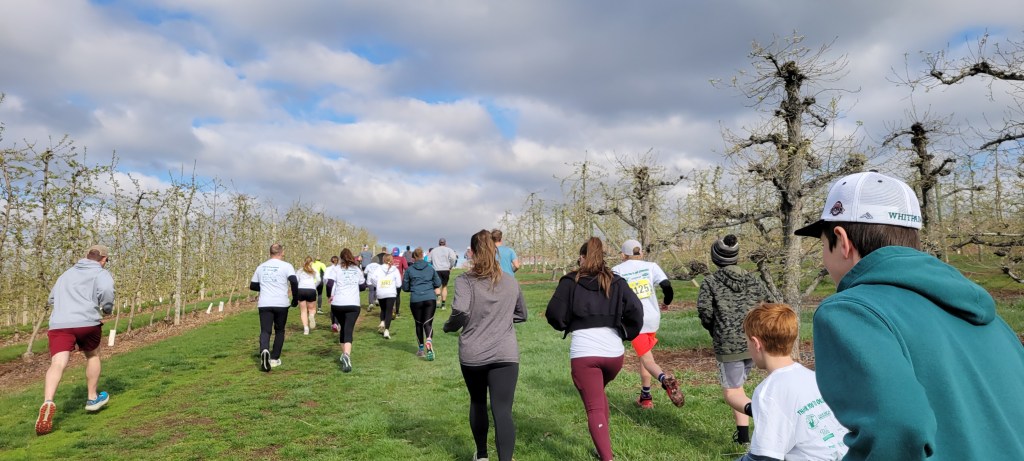
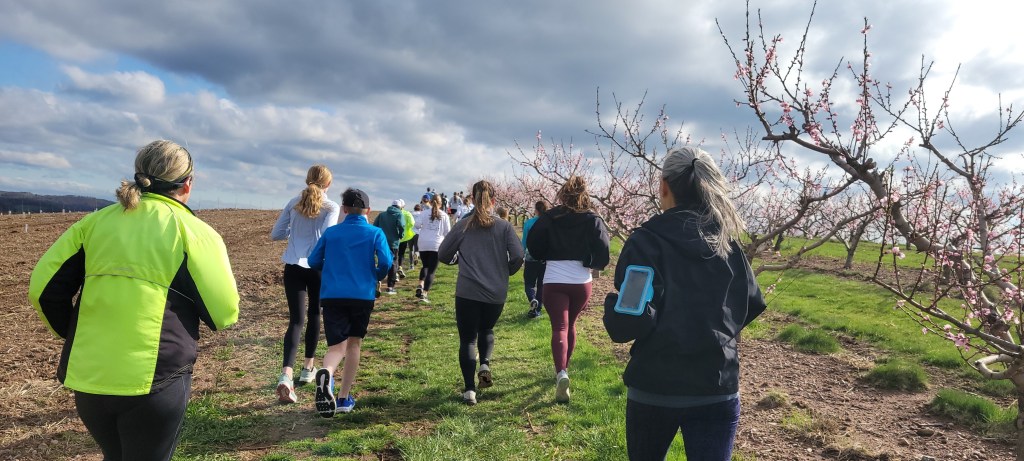
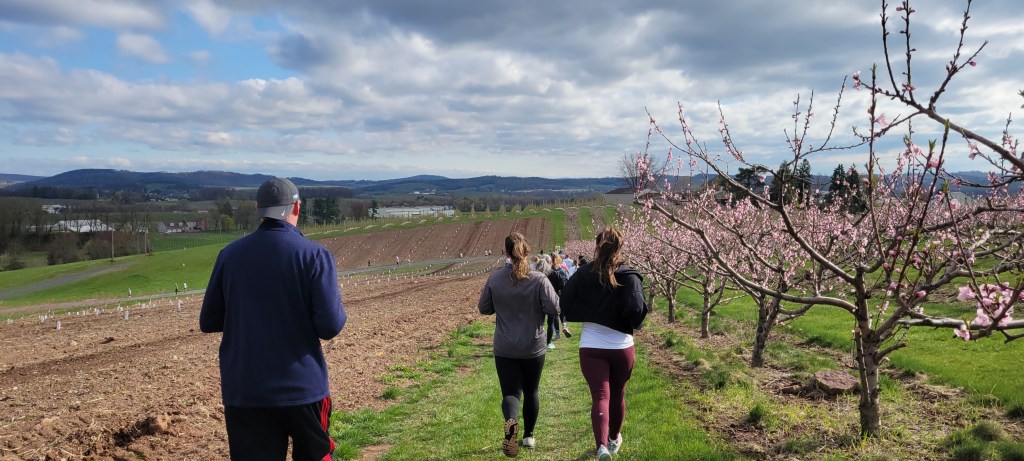
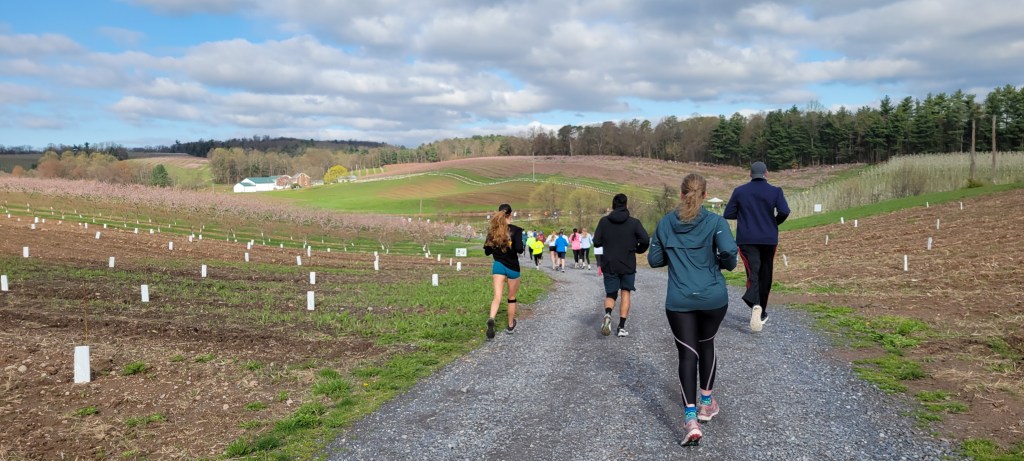
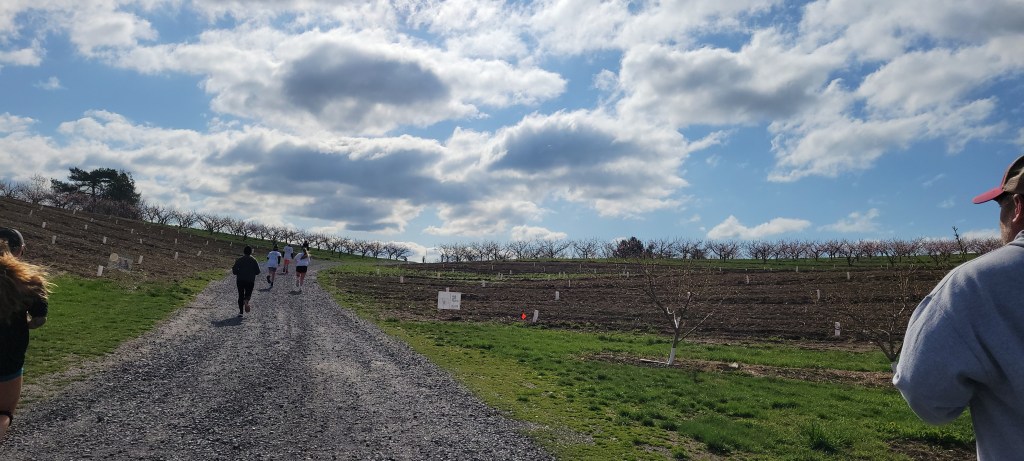
The course ran a meandering loop through rolling apple, pear, and peach orchards. Like a cross country course, it ran on ungroomed ground rather than road. The race had short stretches on dirt and gravel farm paths and a hundred-yard stretch on paved road, but mostly trod upon the grassy throughfares beside and between orchard blocks. And like many cross country courses, it was hilly.
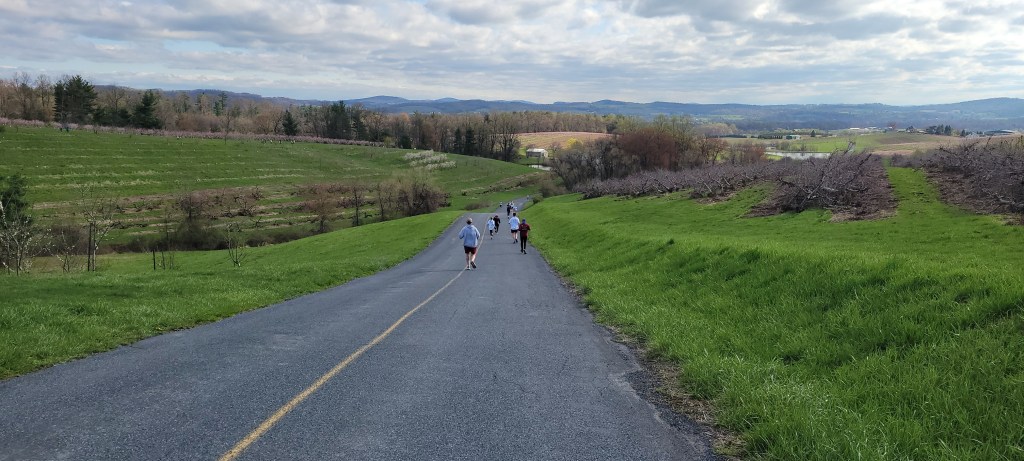
It had real hills. Hills that made you feel it. Hills that made you whimper. And they snuck up on you. Because of the course’s turns, contours, and fruit trees, you couldn’t always tell when a hill was coming or when it would end. It had a Mile 2 uphill over half a mile long with blind turns and a sneaky (and mean) false summit, and it had hills in Miles 1 and 3 to keep you honest. In general, there was more uphill on the way out than on the way back – but the way out was a mile longer than the way back.
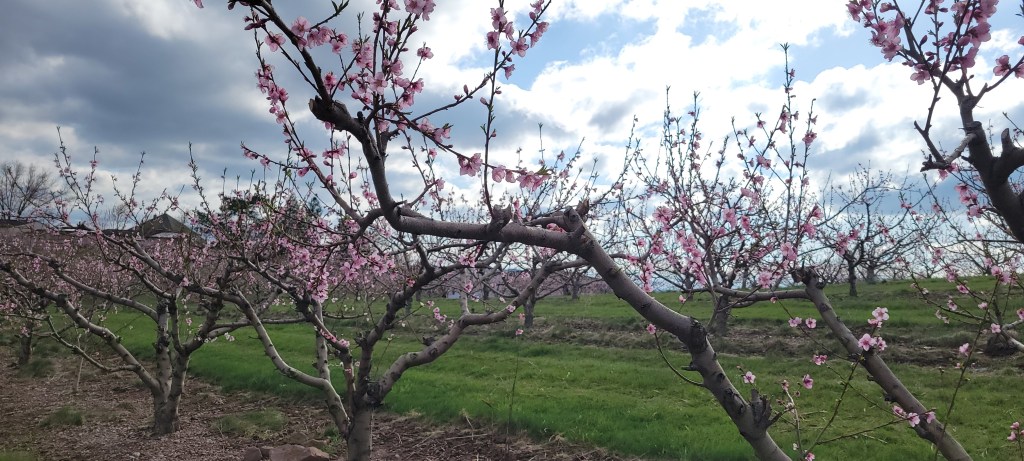
The bug of the hills was offset by the beauty of the course. Blooming apple and pear blossoms draped the orchards. Quilted waves of farmland rolled to the horizon under sunny skies. Crisp, 50-degree air gave the pleasure of autumn on a spring day.
Julie finished 7th of 40 in her age group, 20th of 137 among females, and 54th of 217 overall. Ryan finished 1st of 20 in his age group, 10th of 80 among males, and 13th of 217 overall.
There were some good runners in the field, including several runners who had sub-16:00 5Ks under their belts, but this course wasn’t built for speed. The winning time was 20:09 – a 6:29 per mile pace. That’s pretty good for weekend warriors, but the top two finishers likely would have run several minutes faster on a paved, less hilly course.
This race wasn’t about fast times, though. It was about Bruce and his family, farm, and community. It was nice to be part of it.











Detailed Race Report for Running Nerds
Our 49th State race was a serious contender for the hardest of them all. The only other races in contention for the title would be those from the nearby east coast states of Vermont, Maine, Maryland, and New Jersey. The only thing that might not make it hands down the hardest of our races was the temperature. Those other races had the hills and surprises of a trail run, but also had blazing heat in the summer heat wave. Our Georgia race had a serious hill for the last two thirds of a mile and plenty of ups and downs beforehand too, so that puts it in the running as well. But, even after reflecting on the difficulty of each course, the hills of Hollanbaugh Orchard may manage to get one toe over the line ahead of them all, despite the perfect running weather. Add onto that, it being our 49th State race, and both of us having tired bodies to overcome at this point on the journey, we think it’s safe to give it the crown as our most difficult race yet.
Luckily, it may also have been the most beautiful of the 50 races that we’ve done so far (49 states plus 1 District of Columbia). And it almost didn’t happen. The fact that the race directors welcomed us into the race, even though the registration cap was maxed out, and did so so enthusiastically and warmly, took it to another level. Add onto that the heartwarming sense of community rallying in remembrance of a loved one lost and how the race was dedicated to him with such a palpable love and care, the race was one of the most beautiful of those we’ve done for reasons more than just the stunning scenery and perfect weather.
All of this setting is an important backdrop for fully understanding each of our race reports. When you combine something hard with something beautiful, something particularly rich is produced on the other side. It is in those conditions that one can get a glimpse of things as precious as the power of the human spirit, and that makes good fuel and good memories.
As for the race itself, Ryan had a rougher race than usual when it comes to the physical component of it.
On a flat course he may have been able to go about his business without too much noticing of the fundamental tiredness in his legs that had been accumulating across the miles. But with this course, well, this course was going to beat the truth right out of him with every heart-pounding, foot striking contour and incline. Whether going uphill or down, the earth felt like it was pounding your feet, rather than the other way around. And Ryan was feeling it. In that pounding he noticed the underlying feeling that had been lurking beneath the surface before the race started. With 49 races in 10.5 months already laid on those legs, and most of them run with the intensity of someone working hard to make good time, eventually, the wear of it would show up. And this is where it did.
Ryan came into the race knowing that it would be a hilly course, though not having a full appreciation of the extent. He came in thinking he’d approach the race as a brisk jog, versus his focused racing mindset that he’d been carrying since somewhere around race 11 or 12. Once the course started and the first “small” hill came upon us within less than a quarter mile of the starting line, he realized that even a brisk jog might not be sustainable. Before long, he decided that just hanging on for the duration was a better goal.
Before carrying on describing the roughness of this race for Ryan, keep in mind that he still finished this race in 26:14. For Ryan, this is “slow”. For Julie, that is the time she runs when she is in pretty solid shape.
One of the major upsides to the difficulty of the course for Ryan was the very fact that he realized neither a race pace, nor even a brisk jog, would be a sustainable strategy. This meant that he had more room in his attention to really take in the scenery. When you are really running, focus is paramount, so there is not much room to fully savor your surroundings. If there was any race to be able to take the scenery in, this was the one. The sky was the perfect kind of cloudy and blue. The orchard was green rolling hills against the backdrop of a valley and mountains in the distance, peppered with rows of trees sprouting pink and white and purple blooms. Inside the curves and twists of the course, there were glimmering ponds with sun reflected off of them. It was 3.12 miles of sights worth beholding. The course being so hard that enduring it was the name of the game made the gorgeous views that much more a part of his race experience.
When Ryan turned the corner in the early parts of Mile 2 to begin scaling the mammoth hill, he realized that a brisk jog had never been in the cards at all. He was committed to running the full hill rather than walking. It was partially for the pride of not submitting to the temptation of the walk. At the same time, it was also because he knew that, on a course like this, once you start walking, it gets harder and harder to get going again. Refusing to let the hills break that momentum, he kept himself running up the Mile 2 monster. It was the kind of hill that teased you a little after the first and steepest part with a false summit. As you are climbing the steepest part, you can’t completely see over the top of it. You think you are almost there only to find out when you reach that crest, that you are just beginning a less steep, but much longer hill that stretches out as far in front of you as you can see. Despite that physically discouraging discovery, Ryan maintained a steady jog. When he finally crested the top of the hill and started the descent of the steep and long downhill, he found himself mindful of the pounding on his knees and the dangers of letting himself get too fast with the gravity assist that can also wear you out more than you might expect.
Once Mile 2 was done, he was feeling pretty cooked and pretty ready to see that finish line.
There are some days when you wake up and you are just not in the mood for a run. There are some days when you wake up and, even if you are in the mood for a run, you are not in the mood for a hard run. That was how Ryan started his day. But this was most definitely a hard run. And he felt that incongruence between his mood and the reality of the course throughout the race. He enjoyed the race for the community and for the views. He enjoyed it because it was an interesting course. He enjoyed it because it was a challenge. But it wasn’t the perfect day for him to partake of such a challenge. So, as each mile passed, he found himself looking forward to the finish line. And, by the time he crossed the finish line, he was beat. He even found himself doing the official move of the “I’m spent” person, bending over with his hands on his knees once he made it to the end.
In terms of that aspect of things, Julie had a very different experience. For Julie, this was EXACTLY the race she was in the mood for and she was loving every single second of it. For Julie, this was one of her most enjoyable races of the whole trip, and there were probably a lot of factors feeding into that. For those that have been following along, you know that Julie had, what seemed to be, an inexplicably hard time in the last couple of races, leading Julie to reach the conclusion that her goose was officially cooked and she was solidly in “overtrained” territory and that the only thing she could do from now on was to make it through the last few races and then do some intense resting for at least a month before her system would be ready to rebuild fitness. This had Julie coming into the race with ZERO aspirations of running or racing or time. In the last two races, Julie had struggled with an over responsive heart rate, finding herself hitting a 180+ heart rate at super easy paces of 10:00 min/mile or even slower. So, coming into this race, Julie’s primary goal was to take care of her body and keep that heart rate in reasonable territory. This being a focus took any pressure off, physically and mentally.
Secondly, Julie came into this race well-rested and feeling more physically energized than she had come into the last few races. We had added in a few days of a slightly less intense itinerary pace and some fairly consistent and decent sleep was behind her. It may also have helped that Julie managed to refill her vitamins that she had run out of a couple of weeks ago. It’s hard to say what all the factors are, but no matter what attitude Julie came in with, it was clear that she was entering the race feeling physically more primed than she had the few weeks prior.
When the race started, Julie was super focused on running feeling easy and keeping a nice easy heart rate. When that first hill came up early in the race, Julie decided to take it as slow as she needed to take it to keep that sub 150 heart rate in place. This meant she ran up it at a super slow 12:30 pace. Nice and easy. And her heart rate was loving it. For the first mile, Julie’s heart rate didn’t crack 150. For Julie, this was already a huge success. No matter what hills came, with zero focus on getting a good finish time, Julie just slowed down to whatever pace was necessary to keep running but keep her body feeling relaxed and minimally taxed. On the downhills, she leaned into gravity and let physics do most of the work for her. On the uphills, she gave gravity as little of a fight as she could, focused only on keeping it going, but slowing down as much as possible.
Julie’s only goal in the whole race other than taking care of her body and heart rate was to run the whole course. No walking, no matter how tempting it might become. This was a course that made walkers out of many people. Especially that monster hill in mile 2. Julie had been running slow for the majority of mile 1 so there were plenty of people ahead of her. When that monster hill came and everyone around Julie surrendered into a walk, Julie kept her focus on keeping a run going. After having taken the first mile nice and exceedingly easy with an 11:00 min/mile average pace, she was ready to tackle the monster that was mile 2. Of course, that wasn’t entirely planned. We knew there were hills throughout, and we knew there was a big one in mile 2, but there was nothing we knew that prepared us for how much of a hill there was waiting around that corner.
When Julie started the hill and saw all the runners around her quickly surrender into a walk, she was running so slow up it that, at first, she wasn’t even sure if her running would prove to be any faster than walking. That is, of course, until she started picking off walkers one after another as she scaled the behemoth at her slow plodding pace.
Now, Julie’s heart rate did get up to 180 and past it – but this time, it was for the appropriate reason! Running up a hill that was that steep and that long without stopping to walk SHOULD get your heart rate up! And Julie’s shins did start talking a little for the first time in a while. Usually, that would be another sign of a an overtaxed system, but relentless hills like this SHOULD bring those old injuries to the surface – they only showed up a little and Julie was running at paces that were manageable, so, as soon as the worst of the hills were over, they settled down as quickly as they had flared up.
And the roll of the hills, the sheen of the waters, the glow of the trees in bloom, the perfect running temperature and the gorgeous blue skies were like a slice of heaven to run through and Julie was soaking up and savoring every teeny morsel of beauty that was painted across the panorama. Julie couldn’t stop snapping pictures. Each new view seemed too beautiful not to record.
There was no point in the race where Julie felt tired or pounded by the terrain, despite how objectively difficult a course it was, and this was a welcome and unexpected joy after 2 flat and easy courses had left Julie feeling frustratingly exhausted and beat up.
When Julie came up to the massive downhill in mile 2 after the brutal uphill, she used the first half of it to start to bring her heart rate back down and it, thankfully, responded. When she is really in an overtaxed mode, her heart rate refuses to come down even when the opportunity is there. Even though downhills can be easier on the heart rate, if you really lean into the gravity and let yourself pick up some real speed, you can still get your heart rate up pretty good as it struggles to keep up with an unnaturally fast pace of the turnover of your legs. So, for the first half of that huge downhill, Julie kept the faster downhill pace to a modest low 9s. Once she saw her heart rate begin to even out below 180 and move ever downward, she shifted her body weight to go from leaning back against the pull of gravity, to leaning forward and right into it. All of a sudden, her legs needed to start to rotate faster and faster to keep up with the forces at play. Julie ran the last half of the downhill at about a 7:35 pace, a far cry from the 15:30’s she used to climb up it. Ultimately, she finished that mammoth mile at a respectable for the terrain 12:38.
When it came time for mile 3, for the first time in a long while, thanks to good rest and running the first 2 miles exceedingly easy and slow, Julie had a tank that was more than full, even though, in the big picture, her body was still in en empty tank kind of mode, in need of some serious refilling. So, while she still stayed focused on not doing any fast running, there was plenty left to pick up the pace a little. She cruised down the downhills and took it easy on the uphills until mile 2.88 when Julie turned the final corner and saw another hill. This one was nothing compared to the mile 2 hill, but, on any other course, would have been considered a decent climb. There were some runners that ran it, some that surrendered to a walk. For Julie, thinking that the finish line might be one long downhill on the other side of it, decided to run up the hill – not plod – run. It felt so good to take her foot off the breaks that she had kept as a top priority for the prior 2.88 miles of the race. Despite being overtaxed in the big picture, Julie’s body still wanted that rush of really running. She felt the hill disappear underneath her energized legs. Her heart rate popped over 180 as she added speed to incline, but she felt it with a sense of invigoration. She managed to finish mile 3 at a 9:30.
When Julie crested the top of the hill and saw it wasn’t the last hill before the finish line, she was proud that she was still able to turn the restraint back on with her top priority being taking care of her body and her overall wellbeing, despite any rush of adrenaline and hunger for the speed and the finish line. For that last hill, which was a small hill by any measure, Julie allowed herself to slow down once again. But, when the hill was done and the finish line was a short .12 miles ahead and around that curve, Julie let herself sprint a little. If there are 5 levels of a sprint in Julie’s capacity, this sprint felt like about a 3 out of 5. It felt good to let the legs stretch out and the feeling of speed rush through her body. She finished that last .12 of a mile at an average of 7:20, though, by the time she sprinted across the finish line, she was doing it at a 4:34 pace.
The best part was how Julie felt after the race. There was no leaning over with palms on knees. There was no nausea from the high heart rate or rush of speed over the finish line. There was no need to go for a cool down walk just to get back to feeling human. Julie felt energized and invigorated in the minute after, the hour after and it wasn’t until 5PM later that day that Julie started to feel beat and in strong need of rest. This was also uncharacteristic of the prior few races where she was so spent by the race, she could barely get through the rest of the day’s activities at all. Julie had plenty of juice to tackle the two hour drive to Philly, the enjoyment of a 76ers game and a little Philly exploring before her body was begging for rest.
And, for days afterwards Julie was saying, “I can still feel the invigoration of the race!” This was definitely a surprise twist. Maybe Julie is going to get her dream of being able to run our 50th State race with some real energy and maybe even some real times. It is clear that her body is way too tired to put up times anywhere close to the first couple of races of the trip, but, it’s possible that she will be able to enjoy moments of real running. We shall see. No matter what happens in the next race, state #49, for Julie was an unexpected triumph of sorts and a truly great race.
Ryan had a rough race, Julie had an invigorating one. When reflecting on it, Julie commented, “Well, imagine how you might have felt if you took 34 minutes to complete the race,” which is how long it took Julie. “It probably would have felt a lot more relaxing for you at that pace. I can’t imagine how I would feel if I ran those miles in 26 minutes!”
We both tackled the course without stopping to walk at all – a goal we were both pretty locked in on. We both were able to take deep breaths and enjoy the beauty of the scenery and we both walked away grateful for such a warm community experience on a beautiful, crisp spring day.
 R and J in the USA
Leave a comment